Author: Pamela

  • Millennial Curse

    Millennial Curse

    What is a millennial curse? We are always full of hope when a little one is born. Yet, we don’t need a crystal ball to know their future. It is already fixed.

    In almost any country, we only really spend time with our kids the first six years of their lives. After that, it is school for the next 12 years, and then university for another four to 12 years.

    By the time we leave school to start work, we are often in our twenties. Some start a new life after that while others are stuck with a student loan.

    No matter. Everybody will end up working like crazy for the next 35 to 40 years to pay all sorts of loans : mortgage, auto, renovation, business, holiday, furniture, personal and credit card.

    Then in our sixties and onward, we spend time looking after our health. Sadly, very few manage to deviate from this kind of life. Which to me, is a curse.

    Why are we in this predicament?

    Many people say that they want to be financially viable first before building a family. The rate things are going, young people will have to build their families later and later. We end up with a crazy TFR (total fertility rate). Singapore (1.26) together with some of our Asian neighbours, Taiwan (1.21), South Korea (1.33), Hong Kong (1.33) have some of the lowest TFR in the world.

    It is funny, many developing countries want lower TFR and developed countries lament the same falling rate. For me, I worry whether my five children will be worked to their bones paying taxes so that their children can go to good schools and my peers can continue to enjoy free quality medical services, nice roads, good airport terminals and beautiful parks.

    I muse myself with solutions for years… can we innovate around older ways of doing things instead of pushing forward with the way things are blindly? Will small changes create great impacts?

    What if we reverse the order, and make building family a priority over building a career? If we build a family first with the help of our younger grandparents, the young parents can focus on their work or higher/post-graduate education. By the time the grandparents are aged, the grandchildren are already working adults. Wouldn’t that lift the pressure off the parents and the society? In their prime (thirties), they can focus on their careers as their kids are school-goers and not babies.

    People often ask me what my ideal world is. Quite simply, I want to see children and students passionate about what they learn. I want to see adults having their dreams fulfilled. I want older people to feel valued by the society and their families. That’s so simple, yet so difficult.

    I think we have progressed but we have been impoverished as a result. Our education has removed the individuality out of our children. Our work has taken the meaning out of everyday life in our adults. Our retirement has taken the life out of us.

    Sometimes, it is a matter of rethinking the priorities, and revisiting the old. Sometimes, it is just so simple.

  • Babies Reading

    Babies Reading


    When he found out that I was going to leave the university, the Interim Dean of SMU’s school of business told me he had an important task for me to do.

    “Do something about it, Pam, so that our children don’t have to waste their lives in tuition centers, so that our parents don’t have to spend all those money on tuition.”

    As university lecturers, we are concerned about students who come to us “overtuitioned”. And while they do produce sterling ‘A’ levels and IB results, they don’t necessary make the best university students.

    Since I had my own children to mind after I left the university as a lecturer, I could not work full-time. I decided to put up seminars to train parents to teach their own kids so that they don’t have to outsource their kids to other people. I wanted children to spend time with parents.

    So I crafted some seminars (many of which I have retired now), one of which is the “How to teach your baby how to read”.

    Fortunately, every parent who attended and who bothered to spend five minutes a day with their kids managed to get them reading in three months. Many have written to me to tell me how miraculous it is.

    But it is really not a miracle.

    You see, like every first-time parent, I wanted to raise Oldest Boy well but I didn’t know how. In a time when there was no social media and websites were hardly heard of, I scoured the bookstores for information on how to raise my kids well. I bought every single book.

    From these books, I learned how to teach my son how to read, how to be physically excellent, how to play, how to prepare him for academic pursuits, how to ride a bike etc etc etc.

    When accompanying my husband on one of his business trips to the US, I visited a well-known child brain development professor who taught me how to teach babies to read and explained to me why it is important. Old Boy was only three months old, then. Impressed and convinced, I thought of starting a center to teach babies how to read when I returned to Asia but my career got in the way.

    That was 26 years ago.

    Now, after working with thousands of parents, I know for a fact that if we want our children to read well, we have to teach them ourselves. The reasons are: a. it saves you thousands and thousands. b. it gives you back the time with the child. c. the child will love to read for the rest of his life d. you will learn a whole lot about motivating your child, his learning style and his passion.

    So instead of a center for teaching children to read (of which I can earn a lot more), I decided to teach parents in one day how to teach their babies. I have distilled down what the child brain guru taught me into a seminar and taught it many times. Parents from as far as China and the Middle East, Hong Kong, and South east Asia traveled to learn from me.

    Actually, it is not about teaching a child to read. It is about how to teach the love for books. Once you have achieved that, you will open up a world of imagination for them and help them with their creativity. I also explained why activating creativity is the highest level of learning to achieve in the academia.

    Over the years, people ask how a child with dyslexia could learn to read using the same method. The key is to teach them before they are diagnosed. People ask how me how to motivate a child. The key is to have him so interested, you don’t have to motivate him.

    Once a child can read, they can read everything and become really knowledgeable. Many of my old participants have come forward to tell me how their kids have made it to gifted programs, become early entrants to universities etc etc. Although I am not surprised, I become a little concerned as well.

    I realized, while I taught the parents how to teach small children to love to read, I had not taught them how to satiate that thirst, how to avoid the good and bad consequences (e.g. eyesight, attention in class) of loving to read, and how to work on motivation in other areas.

    We have also found that there is a vast difference in engagement in a child who reads young. A child who reads younger has a different level of engagement from a child who reads even a year or two older. This engagement cannot be taught.

    This is why I now have a two-day session on how to teach your child to read. While I am confident I can teach the parents how in just a day, I needed another session to address longer term academic issues.

    If you are interested to know how to help your child enjoy his academic pursuit, if you want to know how to motivate them forever, please attend my November seminar. If you cannot afford it, please PM me for a scholarship. If your family is struggling financially, this is even more important because I hope that your child will never have to attend tuition once they have a great foundation, of which I am confident I can help you build as long as you are committed.

  • Testing for Learning

    Testing for Learning

    If testing is part of learning, then why do parents complain that test or exam questions are tough? Though old news, such incidences always amuse and puzzle me.

    (1) How on earth do parents know exam questions

    (2) Why are people complaining EXAM questions are too difficult or not taught in school and

    (3) Why are twelve year olds so stressed about not being to answer a question or two in an exam!

    The Youngest One’s SAT Test

    About three years ago, Youngest One sat for the 4.5-hour-long SAT exam for the very first time. It was his first formal exam. as he had never sat an exam in his life.

    At the exam center, I sat outside waiting the whole time, with food and drinks for his breaks. During the breaks we talked about weird things I no longer recall, I had no clue how many questions he could or could not answer.

    He came home almost crying as he could not answer MANY MANY questions. He said he was going to fail and die. I just laughed and said to wait for the results. There was not a need to know every answer!

    Parents’ Pressure on Child

    Why is it important enough for a parent to want to know the questions a child missed? Imagine the stress on the child to recall and report that. So I thought about this. The child is so pressurized to do well, he wrote out the question and parents agree it is too difficult (presumably because parents also cannot solve?) and then the right thing to do is to question the minister or the ministry? Hm…

    How about this: If a child does not know the answer to a question that is correctly set, should we be encouraging them to read more widely, research extensively and solve problems creatively rather than waiting to be spoon fed by the school teachers or tuition centers.

    Also, it is important to highlight to the child that if the questions are truly so difficult, and nobody in the cohort can answer then it is level playing field for everyone.

    Our folks complain that the education system is narrow, limited etc etc. While this is true to some extent, I feel that the task of expanding a child’s education falls more on the parents’ shoulders. We have the responsibility of widening our kids’ repertoire.

    Students’ Problem Solving Skills

    Students should be encouraged to solve problems in different ways, it makes them more creative and open minded. It might mean losing a mark or two during exams, but being open to try new things is a life skill that will be useful forever.

    Also, why is the child losing his self-esteem or confidence because he cannot solve a few problems in an exam? This is such a sad situation. Is he getting too much pressure from himself, home or school, is he having the wrong expectation of himself or is he a perfectionist that needs psychological care and counseling?

    Testing for Learning

    Keeping a healthy mental state is so vital in the wholesome education of each precious child. On a daily basis, I receive SOS notes from parents of secondary two or three students from secondary schools that take in only gifted children. The pressure they face from the school and the home is unreasonable to say the least. And by the time they reach 14 or 15, they just switch off from the pressure and can no longer function properly as students.

    Yet strangely, when I see signs and warn parents about this, most brush it off as something that can only happen to someone else’s kids. They justify why bad things won’t happen to their very capable kids.

    If we believe that exams are meant to test the ability of a student, if we believe that students should not study to the test, and if we believe that kids should not be subjected to unnecessary pressure, then I believe that nobody should be able to answer all the questions in any exam. Some questions should be so difficult that only 1% or less of the cohort can answer.

    This idea that a student must be taught before he learns is so limiting to the child and in fact, any person, especially as they move on to university studies and work. Who teaches us everything we need to know?

    Conclusion

    This idea that if we cannot do something, it is then someone else’s fault instead of finding a different path is so sad. Kids at such a young age should not be taught such entitlement.

    As to what happened to the Youngest One in the SAT: I don’t know what questions he could not do, and how many he did not answer. I also cannot remember his scores. All I know is that his imperfect score got him into the university he wanted to go to but not the faculty he wanted. He then worked hard and transferred the next year to the course he wanted.

    At 16, he is in his final year in the university and has sat many exams by now. There were times he came home saying he could not answer many questions, there were times he came home happy with his performance. He can get disappointed, but never devastated about his results enough to feel his self-esteem or confidence diminished. No matter how hard the paper is, it is not about the paper or the setter nor is it about him as a person.

    Examination is about how a student has grown as a learner and as a person in handling the pressure, the learning process and the unexpected.

    Failing an exam or a test does not make someone a failure. To ace in it is easy, to let it make our students better people is what we should aim to do.

    Afterall, test and exam is really an important part of learning.

  • Early Entrance Rescued my Son

    Early Entrance Rescued my Son

    [vc_row type=”in_container” full_screen_row_position=”middle” column_margin=”default” column_direction=”default” column_direction_tablet=”default” column_direction_phone=”default” scene_position=”center” text_color=”dark” text_align=”left” row_border_radius=”none” row_border_radius_applies=”bg” overlay_strength=”0.3″ gradient_direction=”left_to_right” shape_divider_position=”bottom” bg_image_animation=”none”][vc_column column_padding=”no-extra-padding” column_padding_tablet=”inherit” column_padding_phone=”inherit” column_padding_position=”all” background_color_opacity=”1″ background_hover_color_opacity=”1″ column_shadow=”none” column_border_radius=”none” column_link_target=”_self” gradient_direction=”left_to_right” overlay_strength=”0.3″ width=”1/1″ tablet_width_inherit=”default” tablet_text_alignment=”default” phone_text_alignment=”default” column_border_width=”none” column_border_style=”solid” bg_image_animation=”none”][vc_column_text]Many years ago, I knew if I did not rescue my son from the system he was in, he would drop out despite being in a top (and excellent) school, Raffles Institution. His interest in school was dying. He was not submitting his homework for any of his class, and his teachers were calling me everyday so that I would watch him do his work. Driving him to school was a chore and I was clueless as to what to do.

    The resources on the Internet were not as comprehensive as they are today, people were not as open and certainly, there was no one to consult with or ask.

    When he was in primary school, I told his principal that he was good at Math when he was in P4. The principal retorted that that he had another whole bunch more brilliant than my son, and was not interested in listening to what my son was doing or was capable of. I was hoping someone would guide me and help me, but such help was not to be found.

    I realized at that point that educators (and they are the same in any country) may be very nice people, but nurturing talent is seldom their priority. They are more interested in raising the masses, their KPIs, and of course, their time.

    They were more concerned with their school ranking and results, so if a boy missed out on his opportunities, then so be it. But “so be it” did not work for me, so I decided I had to search out a path for my child, and I kept believing that as long as I searched hard, I would find solutions.

    I knew at that time that I was probably the only Singaporean seeking alternatives. In the end, my son embarked on a High School program equivalent to an A level when he was P5, all on his own. I tried to tell the principal, hoping he would lend me some support. But he again brushed it aside, saying his other children were probably better and smarter. After that second try, I decided to journey on my own.

    I had second thoughts when he made it to a top secondary school. I thought that perhaps the more challenging work would help, but it didn’t. In the end, I continued to journey on my own.

    Looking back, now I know that all these – the lack of support from educators, and the uninterested ministry all came into my life for a good reason. It is because of them that I became very resilient, I diligently researched institutions of interest in almost every English-speaking country, searched through all possible avenues, and spoke to thousands of people.

    In the end, I chanced upon so many options and opportunities for my children. Thinking back, it is because of the lack of support, that we managed to carve out unique paths for my children, all of whom entered universities and broke records of being the youngest. A far cry from the helpless person I was a few years ago, and I know it was because I chose not to be helpless.

    Some people say it is because I have very gifted children, but I say they were not even recognized or given opportunities by the system, some people say they have talents, but I’d say they were hidden. I have learned that we can achieve whatever our minds’ eyes can see if only we choose to believe.

    So, I hope to encourage you all to just go for anything you want. Whether it is an Ivy League, a scholarship, an early entrant or just seeking an education for your child with a disability.

    Yes, we can make silly dreams come true only if we would believe and then put that belief into action.

    Thank you, my son, for making me work a little harder so that I can know the possibilities that one can achieve just if we look deeper.

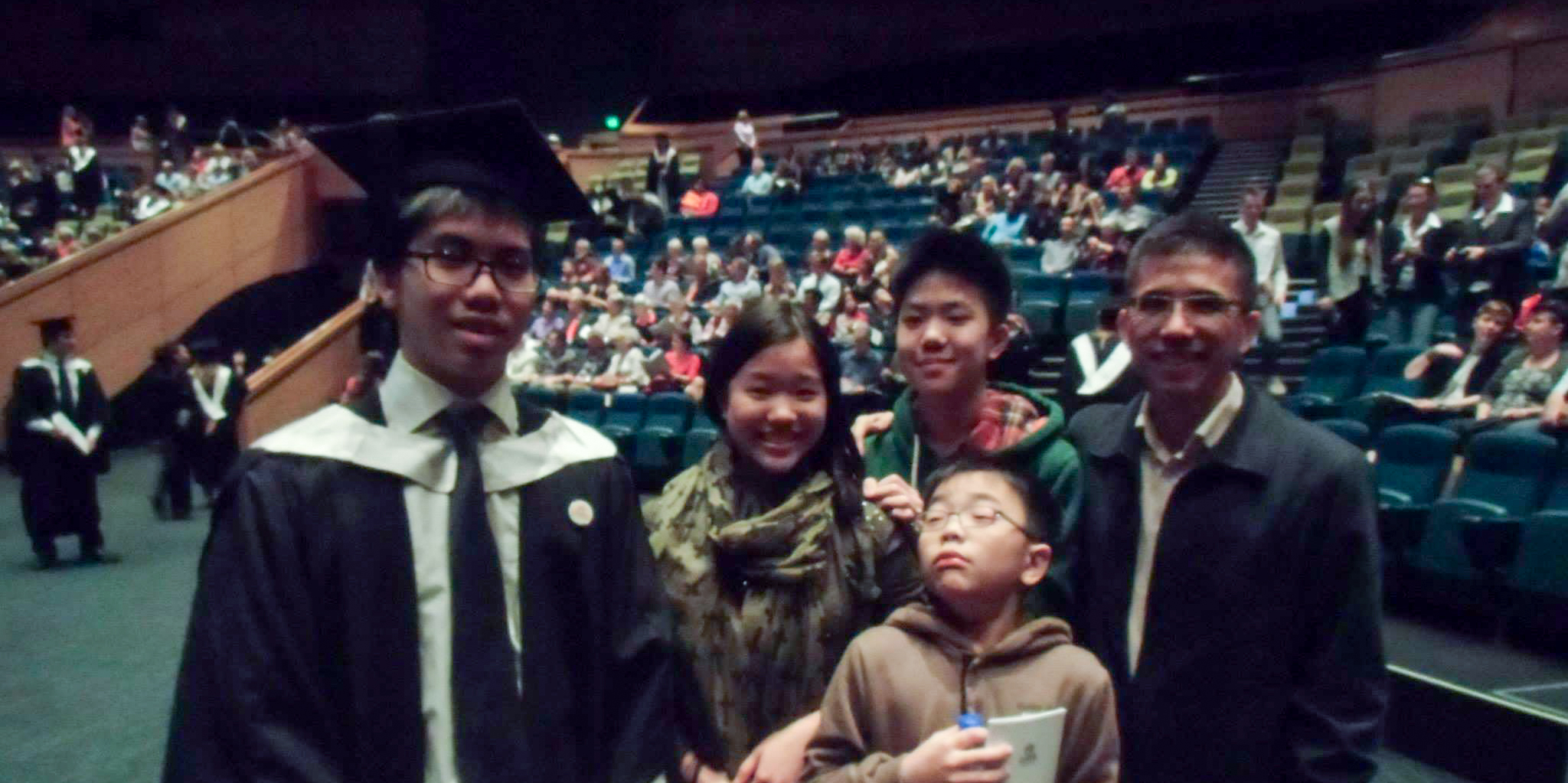
    *The above is what I wrote when Old Boy graduated from the university in 2012 when he was 18. Today, besides the Youngest One who will graduate in 6 months, all my kids have finished their bachelor’s degrees and are either working or finishing their doctorate/Ph.D. As for me, I have made what I learned into a system and gotten our programs accredited so that other children like mine have a chance to achieve their potential, and other parents like me can help their kids become the best versions of themselves.[/vc_column_text][/vc_column][/vc_row]

  • Early Entrance – Youngest Medical Student

    Early Entrance – Youngest Medical Student

    Last week, in All Gifted’s newsletter, I announced that the youngest student to make it to med school is 17-year-old Suki*. And while everyone is happy celebrating her phenomenal success, I only have one wish for her: good health.

    Suki is a very sickly child, and it is for this reason that her mom came to my alternate path seminar 5 years ago to find an alternate path because Suki was missing school constantly due to poor health. Under normal circumstances, her studies would suffer a great deal.

    Over the last five years, not only did Suki* not fall behind, she finished her high school two years ahead of her peers and made it to Monash Medical School. Some say it is a miracle, some might say it is luck but I say it is a wise mother’s decision to believe in her child and then steer her education in the right direction. In the end, Suki achieved what she dreams of.

    While Pat* would only give credits to Suki for being a driven and hardworking student, that alone would not have gotten her this far. Pat told me that she invested one afternoon to hear what alternate paths mean and then, she just got more courage to do what was right for her child. Suki is such a hardworking child, achieving what she did was not difficult as soon as she knew what to do.

    Interestingly, after the newsletter went out, another mother, Atica*, wrote and told me that her daughter will turn 18 before making into the same medical school. She asked me how Suki did it, because saving a year means a lot.

    To me, making into a chosen course in the university in itself should be a celebration. Taking a year longer to graduate should not make her young daughter stressed. Even if it means that she will not be the youngest in the cohort, even if it means taking a year longer, it is still an outstanding achievement.

    More importantly, we should know that we cannot turn back the clock to change things. I just wish Atica had spent just an afternoon with me five years ago. For $200, she would have listened to the alternate paths available, she would have helped her daughter achieve what the latter wants badly now.

    Unfortunately, even if she wants to give me $2000 or $2m now, there is no way I can help turn back the clock or gain back that one or two years they feel they have lost. Although I am confident I would have given them a shorter and happier path, I am not saying they should take it, I just believe everyone should know all options available to them.

    If you have kids between 7 and 20, I encourage you to open your eyes to alternatives available. You don’t have to take these paths, but you must know them.

    I have reduced the cost of Alternate Paths seminar on Jan 4 2020 to $75, hoping to catch all the Aticas. Please do not write to me five years later to ask me to reverse time. I know that I cannot. I am confident every good parent can perform a miracle together with their child, but it has to start very early.

    O, you know what? Even if you don’t come and write me five years later with regrets, I will still be happy to see what I can do to help. So please do feel free to write me anytime!

  • The Gift of Education

    The Gift of Education

    I did not know the gift of education until my own child was not allowed to study with his peers in a public school, and that’s when I realized the best gift to a child is the gift of education.  I started this site to share why I believe every child is gifted and therefore his abilities should be respected and catered to.  I’ll also share my experiences with my five children, and together, we can all gift to our children student-tailored educations which maximize their abilities.

    Even though it was painful when I was left to find solutions myself when some of my kids who were diagnosed with disabilities were not allowed into public school classrooms, I did not wallow.  Instead, I seek to understand my kids’ natural abilities, learning styles and then planned a suitable education for each of them.  As a result, all my five children qualified for respectable universities by fourteen-years-old.

    While on this journey, I learned about existing and unconventional methods of achieving a good education for each of my children. Post by post, I will tell you how this can be done, as well as where I found help and resources. What appears on this site will comprise about half of what will be published in the book scheduled for the first quarter of 2018.

    Nobody is a guru, and I have never believed anyone has the ultimate knowledge in anything. I may know a little more because I spent years researching and have personally walked the paths four and half times with my own kids and another thousands of times with my students. Yet, I believe others have much to contribute as well!

    Why this site

    Through this site, I also hope to get your views and feedback on how to do this better.

    I hope to discover methods to design individualized education plans using modern and classic resources for each child. Thousands of hours of hard work later, we should be another step closer to gifting our children with the best education that suit them.

    I hope readers will:

    • Gain an understanding of who should be responsible in educating the children in the education systems
    • Discover new ways to engage learners in schools and at home
    • Know where to find resources that are available besides those offered traditionally by schools
    • Find suitable instructional design that work and suit the educators and learners
    • Know how to work with and not against the school and current education system to bring out the best in each child
    • Know when and how to engage external help e.g. tutors and coaches to complement teaching
    • Find ways to match what we have learned to the gifts and learning capability of each child

    Hope to hear from you soon, and we will be the first people to write a book with a community.

  • School Readiness

    School Readiness

    “Aye! I am talking to you!” The little six-year-old banged the table as she shouted loudly when her many attempts to hijack the attention from my mother during the latter’s 85th birthday celebration failed. So, I decided to tell her off in public.
    I know. I felt bad after that to have embarrassed my cousin about his daughter’s behavior. So I called him to apologize and offered to spend an afternoon to see if I could help.

    *Ari is not ready for formal school when she starts next year. Despite being a very intelligent child, I believe she will suffer because she is not school ready. No matter how intelligent a child is, she will not do well if she is not ready in other areas. Unless we do something about it.

    After meeting my cousin, I found out that Ari loves to visit the library. So, I gave tips on the kind of books to start her reading with, ways to scale up and then how to help her achieve academically without stress. But on top of that, I taught him how to help her understand her position in the society so that she has the least friction when integrating into the school environment.
    Is your child school ready? Doing well academically and in life is far more than just intelligence or being gifted. It is a set of skills that kids are either born with, or can learn.

    *Ari’s name has been changed to protect her identity.

  • Why I Fight to Keep All Gifted

    Why I Fight to Keep All Gifted

    My friend tried to walk the rest of my life through with me. “Most people die at 85, the last 10 years will not be something fun, so you only have 20 good years. The next five years is a quarter of the rest of your life and the best. So why are you doing this?”

    He asks me why am I still fighting so hard to run All Gifted.

    You have enough and more to retire, you don’t need to run this business. Go learn a new language, do a degree, learn to play a new instrument… something! Not run a company.

    I thought hard about it. It is true. I don’t need to run another company, I don’t need more headaches.

    But what if there are people who will benefit from me running this? All Gifted provides scholarships to students in the Cambodia slumps with the hope of going to Ivy League universities. Their parents had never been even to Phnom Penh.

    Look at Singapore. All we needed were five students who were given educational opportunities and they went to study in Cambridge and other great schools and became our founding fathers. They changed lives for the rest of us – millions of us. I wanted my proteges to change the world because of the educational opportunities only we can provide.

    What if we provide information to young parents, and in one afternoon they change their mindsets of how to raise their children? I have seen thousands of children now acing academically without stress. Seven or eight years later, parents of young gifted program kids write to me or tell me personally how just one afternoon impacted the way they raised their kids.

    What if we provide paths to those who otherwise do not have another? We have low IQ students who were labelled sub-normal and have never attended mainstream schools. Now, they are on the same path as their age-peers academically with our programs. They now have hope to reintegrate as “normal” people.

    What if students who felt incapable from Normal-tech streams can now score distinctions and gain self-esteem as they target world-class universities on our system.

    What if bored students from the GEP who are academically accelerated by five to seven years with us. Students gifted in other areas who found joy in pursuing their other love and still taken care of academically. Imagine the contributions they can give to their communities.

    I think about all these that All Gifted has achieved. For now, I think that it is still worth spending the most precious rest of my life for the purpose of raising the next generation, even though I am almost done raising my own. I think that I have raised my children well, but is now the time to help others raise their children well too? Four of my children are already not dependent on me financially.

    For now, I think I still want to contribute this way. For years now, we have rescued so many otherwise demoralized, bullied, unmotivated, ridiculed, bored and unchallenged students. But for how long more? I am not so sure.

    Can I help you to raise happier, more fulfilled and inspired children? It is important for me because it makes our community a better place. It makes my existence more purposeful.

  • Seminars

    Seminars

    People often ask us why our students are so motivated, enjoy learning, almost always accelerated, high achievers, and make it to gifted programs and Ivy League schools.

    Almost all started with parents attending one of our seminars. Skills learned in just half a day is often applicable for years and for some cases, decades.

    On March 21, I will be conducting 2 seminars: Setting the Foundations Right (for parents whose kids cannot read yet) and Be Academically Gifted (for everybody).

    We will be sharing the strategies to teach your children how to read, academic excellence, raising motivated kids and also entrepreneurship.
    For $125, you will learn something you have never thought about.

    I don’t think there is a parent seminar like ours. So please come. The seminar fees can be fully used as credits for any of our accredited enrichment courses, entrepreneur courses or reading/math programs.

    Just one afternoon, we promise the education of your children will change if you apply what you learn for the rest of your child’s journey. Come and learn how to make it easier for you, your kids and your family.


    https://bit.ly/2TwfE9a

  • Child Psychologist Needed

    Child Psychologist Needed

    Over the last 24 hours, three people had asked me for a reference to psychologists. It is often people whom you least think need help who need help. It is often parents who think their child are doing great who get the biggest shock of the life all of a sudden.

    Anthony’s PSLE result was sterling and he got into an elite of elite secondary school, one that promises more than academic rigor, their high school credits can be used as credit transfers into a top university in Singapore.

    Needless to say, it is a sought after secondary school, and the kids are studying 3-4 years ahead of their age peers in the areas they specialize in.

    The celebration was short-lived. Within six months, the parents reached out to me. The high IQ child has school refusal problems. So I got our counselors involved to see how we can help.

    Our advice was to remove him from a toxic environment where kids are often driven to a place where they feel deflated, over challenged and unaccomplished. We feel he should go to where his gifts are appreciated, where he can score well and his self-esteem is high. On the side, we promised to offer enrichment that will challenge and stimulate his intellectual needs. We felt he needed both social and intellectual support, and since he cannot get them both in the same place, we suggest splitting them.

    Not unexpectedly, the parents and child felt that it was a ‘waste’ to give up a prestigious school, so they stayed. Yesterday, we received another call. In the six months since we last spoke, the child moved to an international school, and now refuse to go to the new school as well. In fact, he is refusing to get out of the house, so can we send in some psychologist.

    To be honest, I don’t think we can ‘rescue’ a child like that, no matter how much they offer to pay us. He is only 14, and just 2 years ago, he was acing his cohort, happy about his situation, full of confidence of his future.

    That is how fragile our kids are. People often ask me why I am so drastic whenever I feel my (or other people’s) children are endangered. And the answer is because sometimes, it can be a point of no return.

    There are cases we know we cannot help, and I honestly feel sad about it. This family did not pay us anything to help them, so it is not even a customer relationship, yet I feel sad that someone I have never met has a situation I don’t wish upon anyone.

    I chanced upon something I wrote when Sunshine Boy was going through some difficulties in school. It still resonates with me today. I hope it is useful to those of us who still think hope or are proud that our kids are child prodigy.

    It is not fun to have a child prodigy, it is far more fun to raise an adult who loves himself and the world. To this end, I think I did a decent job, for this Sunshine Boy is now 20, and he is a well adjusted individual who is capable of handling his life, and has compassion. I think it worth being the strong mum.

    *If you have a child who needs help, please feel free to reach out to me via message, it costs you nothing but a bit of time, but sometimes, that’s all it takes to rescue a child. I don’t charge or judge.

    Here is what I wrote 10 years ago when I decided to wean him from psychologists and, to the horror of educators, gave him an individualized education path instead:

    1. I’d rather my child not be child prodigy, for there’re just that handful of prodigies who truly make it as adults. I wish he’ll discover more about himself than quantum theory.

    2. I’d rather have him see the world, than having the world recognise him.

    3. I’d rather not have him write for publication and peer evaluators but to touch the hearts and minds of common people, to reach out to them and be relevant to them.

    4. If he chooses to follow my footsteps and become an academic, I’d rather he not publish at 10, but at 90.

    5. I’d not expose him to the press, and I’d not find joy in telling the world how smart he is. I’d wish him a few true friends whom he can share small successes with, run with the guys and enjoy a good laugh at each other’s stupidity and mistakes.

    6. I’d not take pain to show case his difference. I’d rather rejoice in him being just the same as the neighbour’s boy.

    7. I’d not show the world how bitter I am when the rest of the world disagree with the way I should view my son, but take the opportunity to show him what grace and forgiveness is about. This is not a fair world and we should never demand it to be.

    8. If I have my choice, I’d want my son’s IQ be to around 120, and an EQ of 210 (if there’s a measurement of EQ). Add a kind heart and a love for living, joy and not bitterness, the ability to present and have his ideas accepted. A sympathy for the poor and respect for the old. A love for his country, patriotism, filial piety, gratitude, politeness, forgiveness, and most importantly, humility. In other words, VALUES. I want him to value principles more than academic knowledge.

    BUT these are just my thoughts. I don’t think I have, don’t wish to have and don’t need to have a kid prodigy. I just wished the world would accept him the way he is and allow him the simplicities of life, a chance to be one of the boys.