Archive for the ‘Our Philosophy’ Category

The AI Flux

Why the influencers urging us to learn AI in five days are actually drifting with it — and what doesn’t move under your feet.


I get sent these constantly. The reels, the carousels, the threads. An influencer telling me to get off social media and spend the next five days learning AI. Then another. Then another.

They are telling me this on social media.

For a while I tried to follow them. One course, then the next. A new framework. A new tool. A new “must-watch” five-hour playlist. The output went up. I built workflows. I shipped things faster than I had before. Measurably faster. There was real productivity gain.

But somewhere in the third or fourth round, something else set in. Not just fatigue.

The pace was not the problem

The companies these influencers were pointing me at were outdoing each other in a matter of days. The influencers themselves were learning at neckbreaking pace, saying the same thing in different ways, or different things in the same ways. The volume was enormous. The signal was unstable.

Every week brought a new agent framework, a new model release, a new “this changes everything” announcement. Every course I had taken last quarter referenced a tool that had been deprecated, redesigned, or absorbed into something larger. Every workflow I had built required maintenance just to keep functioning, let alone to incorporate the new capabilities I was supposed to be learning about.

I was running faster and arriving at the same place.

There is a name for this

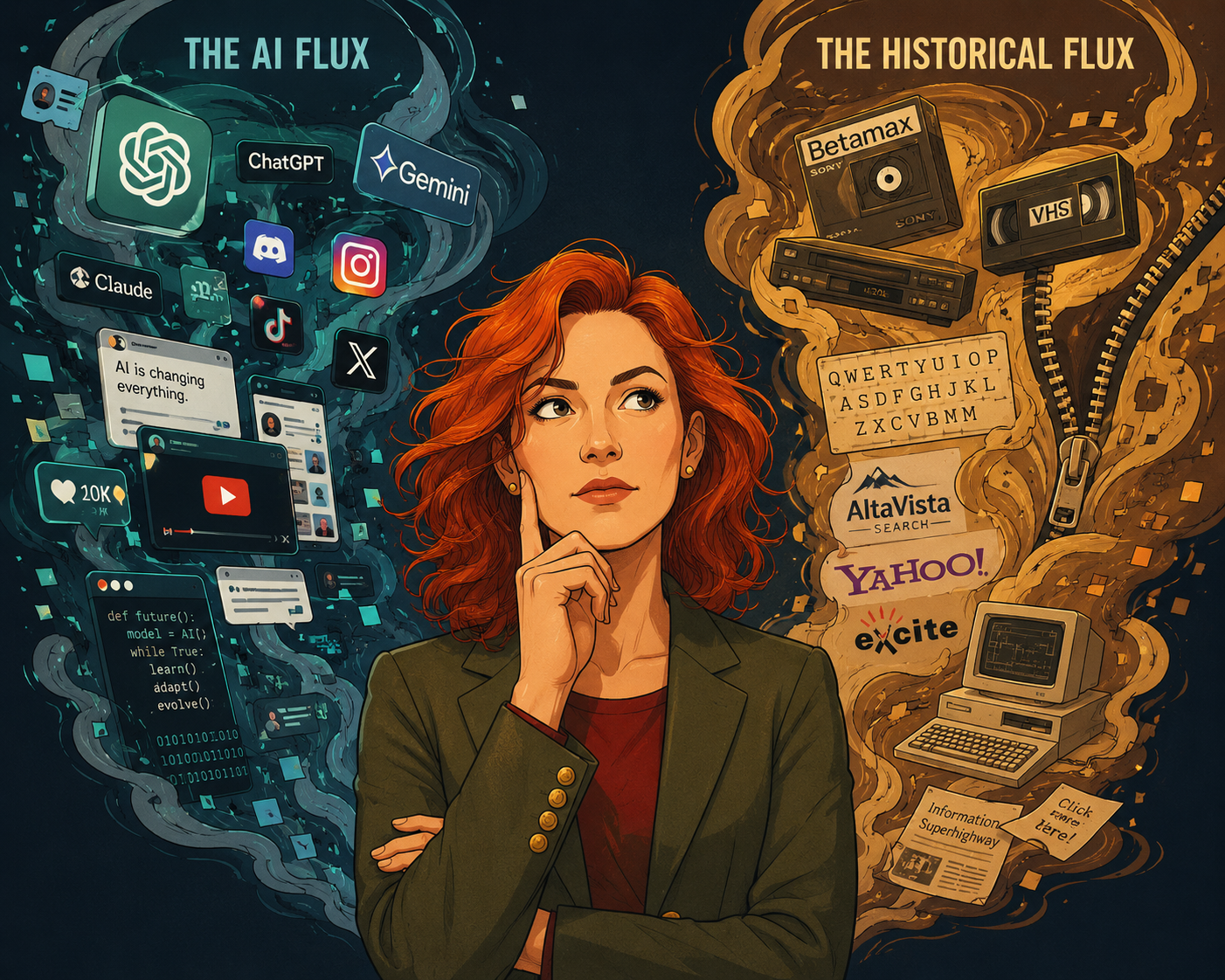
Utterback and Abernathy, in their work on industry dynamics, called it the fluid phase. I used to teach it at Singapore Management University, where I called it the period of flux. It is the stage every major technology passes through before a dominant design emerges, before any standard crystallises, before the market has decided what the technology actually is.

In the fluid phase, competition is on functionality rather than cost. Entry is easy. Failure rates are high. Many designs compete; most disappear. The phase ends when one design — usually not the technically best, but the one that captures the network — becomes the standard. From that moment forward, the industry shifts into incremental refinement.

QWERTY beat Dvorak. VHS beat Betamax. The iPhone form factor beat everything else. None of those outcomes were obvious during the fluid phase.

AI is in the fluid phase now.

The transformer architecture is settled at the model layer, but everything above it is contested. Agent frameworks, application interfaces, deployment topologies, evaluation methods, pricing models, regulatory regimes, even the question of what an “AI product” is — all in active experimentation. There is no QWERTY for AI yet.

This explains the noise

This is why so many companies exist. This is why they outdo each other every week. This is why influencers proliferate. There is no settled answer for them to converge on, so they generate variants — some useful, most noise.

It is also why what you learn in five days may be useless in a few months. Tools will be replaced. Frameworks will be rewritten. The agent stack you built workflows on top of last quarter has competitors this quarter that work on different principles. Anyone selling you a fixed curriculum on a moving target is selling you yesterday’s snapshot.

This is not a failure of effort. It is structural. No five-day course can teach a technology that will reorganise itself before the course is over.

The deeper danger is the drift

But the pace, exhausting as it is, is not the real problem. The real problem is the drift.

AI drift cuts in two directions.

The AI itself drifts. Models change. Capabilities shift. The behaviour of the same prompt is not the same six months apart. What you taught yourself to do with last quarter’s tool no longer works the same way with this quarter’s. Fine. That is the technology, and the technology is what it is.

The human drifts too. This is the danger no one is naming.

After enough rounds of letting the model finish your sentences, your sentences start to sound like the model’s. After enough rounds of accepting the first plausible output, you stop noticing what is wrong with it. After enough rounds of optimising for the prompt that gets the result, you forget what the question was. Your judgment bends toward the tool. Your voice homogenises. Your attention shortens. Your originality, the strange and idiosyncratic angle that was yours alone, gets sanded down by repeated contact with statistical averages.

You become slightly more productive. You also become slightly less yourself.

Two drifts compounding against each other. A moving target tracked by a deteriorating compass. The technology won’t sit still long enough for you to learn it. You won’t sit still long enough to remember what you used to think. After eighteen months of this, you have shipped a great deal and become someone you do not quite recognise.

So what is the alternative?

Anchoring.

There are capacities that do not drift because they are not built on any particular model. They predate AI. They will outlast whichever architecture wins. They compound across every shift because they were never tied to one.

Reading deeply. Not summaries. Not threads. The actual book, with the actual difficulty, at the pace the writer intended.

Writing your own first drafts. Whatever you finally show the model, get something on the page first that is unmistakably yours. The drafts you let the model write for you are drafts you do not learn from.

Building one thing carefully instead of skimming twenty. Depth in any one domain — even an unfashionable one — produces judgment that cross-applies. Skimming twenty produces nothing that cross-applies to anything.

Defending your own ideas against your own scrutiny before any model sees them. The model will not push back on you in the way a serious mind would. You have to be that mind for yourself first.

These are slow. They are not five-day skills. They are not even five-month skills. They are the slow-built capacities that make you ready for whichever dominant design eventually wins — and that keep your judgment, your voice, and your attention intact while you wait to find out which one it is.

The inversion

Get off social media. Yes.

But not to learn AI in five days.

Get off to rebuild the attention span you will need to navigate a decade of flux. To recover the depth of thought that the fluid phase rewards. To keep from drifting with the very technology you are trying to learn.

The five-day course is the opposite of what the moment requires.

The moment requires the discipline of staying yourself while the ground moves.
The Most Important Teacher Skill

Some Teachers Suck

“Don’t be a teacher that sucks!” I stared at my trainer at Republic Polytechnic, not quite believing my ears. So what is the most important teacher skill?

Yes, she looked straight into my eyes. Some teachers are just horrible, she reminded me.

Unfortunately, from experience, what she spoken the truth. I have met so many friends and relatives who became teachers. While some truly want to change people’s lives and inspire, most I have met became teachers because it pays, and they tell me so blatantly. Often, after they have failed to get other jobs.

Those who can, do; those who can’t, teach. I believed this all my life until I had no choice but to give up my own career and became an instructor in the university.

Discovering Teaching

Teaching was the wilderness to me. I have always seen myself as an entrepreneur, the founder and the CEO of companies. I like to negotiate with world-class businessmen and close multi-million dollars deals, I like to sit on government round-tables to give suggestions, I like to strategize and second guess and beat the market trend.

But as it turned out, I had actually forgotten how much I love to teach: it’s much better than being an air stewardess visiting the world, it is much better than sitting on the same table with who’s who during a gala dinner. Those were great, but teaching is far greater.

Teaching Failing Students

At 15, I started teaching as a tuition teacher as I wanted to be independent. My student was just three years younger and he had one month to taking his PSLE exams. He had failed his preliminary math exam, so his mother wanted me to perform a miracle.

This little boy came to my house twice a week for a month and I had no clue if I could help him. But I knew how to make him laugh and think. I would create Math questions with him as the protagonist. He laughed and participated in my jokes. At the end of the month, his mom did not pay me.

However, on the day they released the PSLE results, she brought $40 and a gold chain to my house. He had not only passed math, but scored an A.

I realized I could feed myself by telling stories to little children. So, I continued.

Teaching Students with Emotional Needs

The next family that came to me was an Indonesian family with three girls. They lived in a big house in Bishan area with a house keeper, a driver and a maid. Their parents visited them once every month or so.

The youngest daughter was not very interested in studies, so in order to get her to the ‘tuition room’, I had to go to her room to wake her up and carry her school bag.

I became particular good friends with the second daughter, and her academic work was good. Seeing that they were always at home watching the TV, I wanted to tell her a bit about the world. So, I brought her to cut her hair, played badminton with her, bought ingredients to bake cakes with her. In the end, she told me that her parents had asked her who I was, that I could get the youngest girl to start scoring close to full marks for spelling and tests when she used to get zeroes.

But I think she missed the point. The parents were probably scared that I was trying to get too close, so they found ‘less involved’ teachers. I got it. They were rich and had to be careful of people who might have ulterior motives.

Teaching the Capable and Smart

Another memorable family was a 3-generation family that I taught. The kids were the smartest I have ever taught. The boy was Sec 3 and his work was already good. So, I started teaching him Sec 4 additional math and we got him ready for ‘O’ levels when he was in Sec 3. The girl was Primary 5 and I did the same for her for PSLE.

I would bring them cakes that I baked and shared funny jokes. In the end, I had nothing else to teach them as they were so ahead, so I stopped. Many years later, I received messages and photographs from them. They did so well in school and in life.

That was when my career started to take off as well and I stopped teaching. I didn’t resume teaching until decades later, when I had to stay home to mind my children and started teaching in the university.

Teaching in the University

In the university, I was on the Dean’s list every semester I taught. This is not an easy feat, given my colleagues were mostly professors who were highly regarded in their fields.

As I reflect, I think I know why I managed to rank high. Being a great teacher is not about how much subject matter we know, but how much we can inspire our students to learn.

It is no different whether we are teaching students who are failing, those who need more emotional support or those who are already excelling in every aspect. There are always things we can do to motivate them to do better for themselves.

The Most Important Teacher Skill – Teaching People

Over the years, I have taught thousands of students, and people comment that my students really do very well. I always believe that a good teacher can teach almost anything. It is not the curriculum, but how we can inspire our students that counts.

That is my little secret. The secret to why students with learning disabilities who cannot even score 150 at PSLE can catch up and score A’s in high school. The same reason why 11-year-old previously bored students hope that they will prepare for university entrance exams by 14. Same reason why bankers-wannabes or jobless people became great mega-millionaire entrepreneurs after attending my classes.

I actually didn’t do much. My job is really to find what is already in the students and to bring that to the fullest potential. My job is to inspire them to be who they already are deep inside but buried from the noise of the cruel world.

I think, I finally understand what the RP trainer was saying. Most teachers impose too much of themselves on students and ignore what incredible gifts they each already possess. For me, I believe my job is to inspire and motivate through anything I teach. Teaching a subject or curriculum is easy. Teaching people is not. It is about finding the best in that person and finding ways to maximize his potential in the field we teach. People will forget what we teach but they will not forget what we say to them.

Everybody has something to teach and therefore is a teacher in some ways. Everybody has to inspire and motivate. That’s the most important teacher skill we should have.

The Gift of Education

I did not know the gift of education until my own child was not allowed to study with his peers in a public school, and that’s when I realized the best gift to a child is the gift of education.  I started this site to share why I believe every child is gifted and therefore his abilities should be respected and catered to.  I’ll also share my experiences with my five children, and together, we can all gift to our children student-tailored educations which maximize their abilities.

Even though it was painful when I was left to find solutions myself when some of my kids who were diagnosed with disabilities were not allowed into public school classrooms, I did not wallow.  Instead, I seek to understand my kids’ natural abilities, learning styles and then planned a suitable education for each of them.  As a result, all my five children qualified for respectable universities by fourteen-years-old.

While on this journey, I learned about existing and unconventional methods of achieving a good education for each of my children. Post by post, I will tell you how this can be done, as well as where I found help and resources. What appears on this site will comprise about half of what will be published in the book scheduled for the first quarter of 2018.

Nobody is a guru, and I have never believed anyone has the ultimate knowledge in anything. I may know a little more because I spent years researching and have personally walked the paths four and half times with my own kids and another thousands of times with my students. Yet, I believe others have much to contribute as well!

Why this site

Through this site, I also hope to get your views and feedback on how to do this better.

I hope to discover methods to design individualized education plans using modern and classic resources for each child. Thousands of hours of hard work later, we should be another step closer to gifting our children with the best education that suit them.

I hope readers will:

  • Gain an understanding of who should be responsible in educating the children in the education systems
  • Discover new ways to engage learners in schools and at home
  • Know where to find resources that are available besides those offered traditionally by schools
  • Find suitable instructional design that work and suit the educators and learners
  • Know how to work with and not against the school and current education system to bring out the best in each child
  • Know when and how to engage external help e.g. tutors and coaches to complement teaching
  • Find ways to match what we have learned to the gifts and learning capability of each child

Hope to hear from you soon, and we will be the first people to write a book with a community.

Why I Fight to Keep All Gifted

My friend tried to walk the rest of my life through with me. “Most people die at 85, the last 10 years will not be something fun, so you only have 20 good years. The next five years is a quarter of the rest of your life and the best. So why are you doing this?”

He asks me why am I still fighting so hard to run All Gifted.

You have enough and more to retire, you don’t need to run this business. Go learn a new language, do a degree, learn to play a new instrument… something! Not run a company.

I thought hard about it. It is true. I don’t need to run another company, I don’t need more headaches.

But what if there are people who will benefit from me running this? All Gifted provides scholarships to students in the Cambodia slumps with the hope of going to Ivy League universities. Their parents had never been even to Phnom Penh.

Look at Singapore. All we needed were five students who were given educational opportunities and they went to study in Cambridge and other great schools and became our founding fathers. They changed lives for the rest of us – millions of us. I wanted my proteges to change the world because of the educational opportunities only we can provide.

What if we provide information to young parents, and in one afternoon they change their mindsets of how to raise their children? I have seen thousands of children now acing academically without stress. Seven or eight years later, parents of young gifted program kids write to me or tell me personally how just one afternoon impacted the way they raised their kids.

What if we provide paths to those who otherwise do not have another? We have low IQ students who were labelled sub-normal and have never attended mainstream schools. Now, they are on the same path as their age-peers academically with our programs. They now have hope to reintegrate as “normal” people.

What if students who felt incapable from Normal-tech streams can now score distinctions and gain self-esteem as they target world-class universities on our system.

What if bored students from the GEP who are academically accelerated by five to seven years with us. Students gifted in other areas who found joy in pursuing their other love and still taken care of academically. Imagine the contributions they can give to their communities.

I think about all these that All Gifted has achieved. For now, I think that it is still worth spending the most precious rest of my life for the purpose of raising the next generation, even though I am almost done raising my own. I think that I have raised my children well, but is now the time to help others raise their children well too? Four of my children are already not dependent on me financially.

For now, I think I still want to contribute this way. For years now, we have rescued so many otherwise demoralized, bullied, unmotivated, ridiculed, bored and unchallenged students. But for how long more? I am not so sure.

Can I help you to raise happier, more fulfilled and inspired children? It is important for me because it makes our community a better place. It makes my existence more purposeful.

Key To Acceleration

[vc_row type=”in_container” full_screen_row_position=”middle” column_margin=”default” column_direction=”default” column_direction_tablet=”default” column_direction_phone=”default” scene_position=”center” text_color=”dark” text_align=”left” row_border_radius=”none” row_border_radius_applies=”bg” overlay_strength=”0.3″ gradient_direction=”left_to_right” shape_divider_position=”bottom” bg_image_animation=”none”][vc_column column_padding=”no-extra-padding” column_padding_tablet=”inherit” column_padding_phone=”inherit” column_padding_position=”all” background_color_opacity=”1″ background_hover_color_opacity=”1″ column_shadow=”none” column_border_radius=”none” column_link_target=”_self” gradient_direction=”left_to_right” overlay_strength=”0.3″ width=”1/1″ tablet_width_inherit=”default” tablet_text_alignment=”default” phone_text_alignment=”default” column_border_width=”none” column_border_style=”solid” bg_image_animation=”none”][vc_column_text]

What about his Calling?

My son observed this about Singapore’s attitude to education: It is like the driver is concentrating so hard on driving to get to his destination, he refuses to notice there is a highway or a tunnel to make his journey shorter. Everyone is so focused on what he is asked to do, he misses out how to get to his destination better and quicker even when you point him to a short cut.

A Standard Aspiration

It is amazing that many of us are so engrossed in chasing what we are told to for our children that we forget why we are doing so: we fight mindlessly to get into GEP, for good PSLE T-scores, straight As in ‘O’ and ‘A’ levels, perfect IB and GPA scores. So if everyone is closing in on perfect scores, how do we differentiate one perfect scorer from another?

In our gathering where we saw our 13-year-olds meet after their first semester in their respective secondary schools, I am curious what the boys’ plans and career hopes are. Interestingly, my lawyer friend and fellow parent pointed out to me that every single one wants to be either a doctor or a lawyer, but none of them knows why. The none-of-them-knows-why part surprises and worries me.

I don’t believe two classes of 50 gifted students all have the same calling and share just two gifts, so realistically, some will be spending 40 years of their lives doing something they are not passionate about, and that will be so tragic.

Finding an Individual Passion

As a parent, I believe the one single most important responsibility is to help each child find his passion, his purpose and calling in life. It is already sad that many of us who grew up in third world Singapore in the 1970s fail to find these in our entire lives in the name of survival. Yet many of us are passing the same fate to our children.

We parents ferry our children in and out for all sorts of classes to pursue academic excellence but do not know what our children’s passions are. As a society, we judge a student by his GPA or aggregate score in standardized exams like ‘O’, ‘A’ levels and SAT. So what about the area that he really sparkles in, do we look deep into each child’s talent even if it is not measured in standardized exams? Do we spend time to ensure each child gets to pursue his love, his dreams and his career? Do we find time to listen to each child’s heart so that we know his dreams and then help him achieve them?

Acceleration = Finding a Calling Early

The earlier we help our children find their passions in life, the happier they will be, and the earlier they will be on their career paths. Doesn’t this sound perfectly logical? Isn’t that what we all hope to do?

Instead of focusing on our steering wheel and driving the same road we are told to, we can look harder to find that tunnel or highway and that short cut. That accelerated path has been there all along: in each child, and he has been trying to tell us all the time how to lead him to the life he wants. He has been trying to tell us how to differentiate him from the multitudes out there.

Would we be drivers who find the correct roads and paths to help our children get to where they want to go or would we rather insist on the perfect roads to take so that they reach the predestined aka OUR destinations?[/vc_column_text][/vc_column][/vc_row]

How To Develop A Child To The Fullest

Written for psd.gov.sg
Educator and entrepreneur Pamela Lim shares how she brings out the best in a child.
how-to-develop-a-child-to-the-fullest-thumbnail

“Everybody is a genius. But if you judge a fish by its ability to climb a tree, it will live its whole life believing that it is stupid.” ~Albert Einstein.

I grew up thinking I was stupid, simply because I did not fit into the mould of a typically “intelligent” child. I chose to follow only certain instructions, made mistakes trying outrageous new things, questioned and dared to disagree. It was only when I started to run my own companies that I realised that these are not necessarily flaws, and that I do have some positive traits.

For decades, many people believed that giftedness meant a limited set of skills endowed upon an elite group of people. Yet, if we examine those around us, we can see that everyone has some kind of talent that cannot be measured by IQ tests, academic results or the schools attended.

quote

People learn best when they feel they are in control, can achieve and see results.

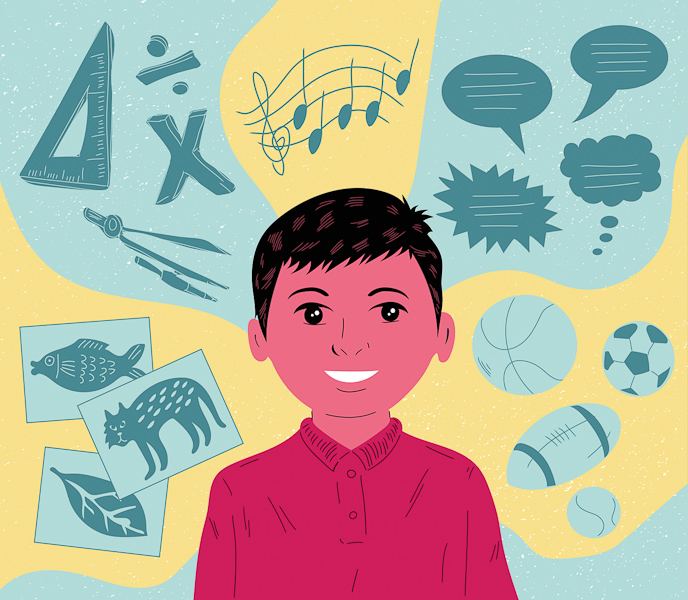
According to Harvard psychology professor Howard Gardner, intelligence can be observed in at least nine areas: musical-rhythmic, visual-spatial, verbal-linguistic, logical-mathematical, bodily-kinaesthetic, existential, interpersonal, intrapersonal and naturalistic. I believe that we can maximise a child’s potential if we put effort into finding the areas he is gifted in, leverage technology to teach him by appealing to his intelligence, and spend more time honing his socio-emotional skills.

Throughout the history of schools, educators have been teaching as if everyone learns the same way. Yet, in a class of 30-40 students, it is hard to find any two who are the same. There will be kinaesthetic students who need to run around, existential students who have too many questions to ask, logical students who need to make mathematical sense out of every subject, and visual students who need to see the pictures in their minds.

People learn best when they feel they are in control, can achieve and see results. It is therefore best to build upon their natural giftedness when teaching something new. When a child is successful in learning in his strongest areas, he will also gain confidence to attempt things he is not naturally good at. A bodily-kinaesthetic child, for instance, needs to move around to learn. So forcing such a student to sit on the same chair for half a day won’t get anything into his brain. Giving him reasons and responsibilities that get him off his seat will motivate him better.

When my son was in kindergarten, he was allowed to walk around the classroom while the teachers taught. When the teachers were done, he could regurgitate everything from the different star constellations to the Seven Wonders of the World, and he was never a difficult student. But when he went on to primary school, he was asked to sit still. He first tried to disturb his friends, then fell asleep most of the day and eventually learned nothing much in school for the next four years.

To cater to children of different needs, many schools around the world are embracing technology. E-learning, videos, games and demonstrations can be used to provide customised learning materials to appeal to children who learn differently. For example, a visual-spatial child can learn quicker when the lessons are presented visually through videos or demonstrations. A verbal-linguistic child can learn mathematics through reading about numbers, a naturalistic child can learn through linking mathematical concepts to nature, an interpersonal child can do activities that appeal to his needs to connect to a larger group.

With technology taking over some of the mundane curriculum delivery, educators can spend more time looking into the students’ psychological, moral, social and emotional needs. Rather than being saddled with delivering academic subjects, teachers are released to connect with the students and teach them what technology cannot: empathy, values and life skills.

Every child (and for that, every person) is a gem, and if we take the effort to discover his gifts, use technology to leverage his gifts to deliver lessons to him effectively, and spend time to nurture the soft skills, then in everyone there is a good chance he can achieve even what his mind’s eyes cannot see.


Pamela Lim, a mother of five, is an entrepreneur and a former lecturer at the Singapore Management University for entrepreneurship and innovation. She runs the online All Gifted High School, which offers courses for homeschooled and school-going children. For more on Howard Gardner’s multiple intelligences: bit.ly/MI_gardner

  • POSTED ON
    Jul 2, 2014
  • TEXT BY
    Pamela Lim
  • ILLUSTRATION BY
    Mushroomhead

We don’t spam! Read more in our privacy policy