Archive for the ‘All Gifted High School’ Category

She Was Sick, Behind, and Scared. All Gifted School Did Not Give Up on Her.

She missed 47 days of school in one year.

Not because she did not want to go. Because her body would not let her.

Chronic illness does not care about school schedules. It does not care about attendance policies, exam timetables, or the pace a class is expected to keep. It simply takes. And when it takes enough days, the system does what systems do — it moves on without you.

When the system cannot flex.

Her mother called me in tears.

“She wants to learn. She is not lazy. She is not difficult. She is sick. And every school we have spoken to says the same thing — she has missed too much. She cannot catch up. She should repeat the year.”

Repeat the year. As if the illness was her fault. As if punishing her with lost time would somehow heal what was broken.

Traditional schools are built on a fixed schedule. Everyone moves together. If you fall behind, the system has limited options — catch-up classes, repeated years, or quiet exits. For a child with a chronic condition, this is not just inconvenient. It is devastating.

What we did differently.

When she came to All Gifted, we did not start with a test. We started with a conversation.

What had she completed? What did she enjoy? What were the good days like — and the bad ones?

Her guidance counsellor mapped out a plan. Not a rigid schedule. A flexible pathway. On good weeks, she could push ahead. On bad weeks, she could slow down. The curriculum did not disappear when she needed rest — it waited for her.

Her mentor met her once a week over video. Sometimes she was in bed. Sometimes she was at a desk. It did not matter. What mattered was that someone showed up for her, consistently, without judgement.

The days she thought she could not do it.

There were days she wanted to quit.

“I am so far behind everyone else. What is the point?”

Her mentor did not give her a motivational speech. He gave her a smaller goal. “Just do this one assignment. Just this one. We will figure out the rest tomorrow.”

And she did. One assignment. Then another. Then a week. Then a term.

She was not racing anyone. She was just moving forward. At her pace. In her way.

What happened next.

She completed her courses. Not on the timeline her old school would have demanded — on her own timeline. She earned her credits. She graduated.

When her mother called me again, she was not crying from frustration. She was crying because her daughter had done something that three schools had told her was impossible.

“You did not give up on her,” she said.

We did not give up on her because giving up on a child is not education. It is abandonment dressed in policy.

This is what individualised learning means.

Individualised learning is not a buzzword. It is not an app. It is not an algorithm that adjusts question difficulty.

It is a human being who knows your child, who builds a plan around their reality, and who stays when things get hard.

At All Gifted, every child has a mentor. Every pathway is personalised. And no child is left behind because the system cannot accommodate them.

Because the system should serve the child. Not the other way around.


If your child is struggling in a traditional school — whether due to illness, learning differences, relocation, or simply because the system does not fit — talk to us. We have seen what is possible when education bends to meet the child. And we would love to show you.
A-Levels vs IB vs US Diploma — What Singapore Parents Actually Need to Know

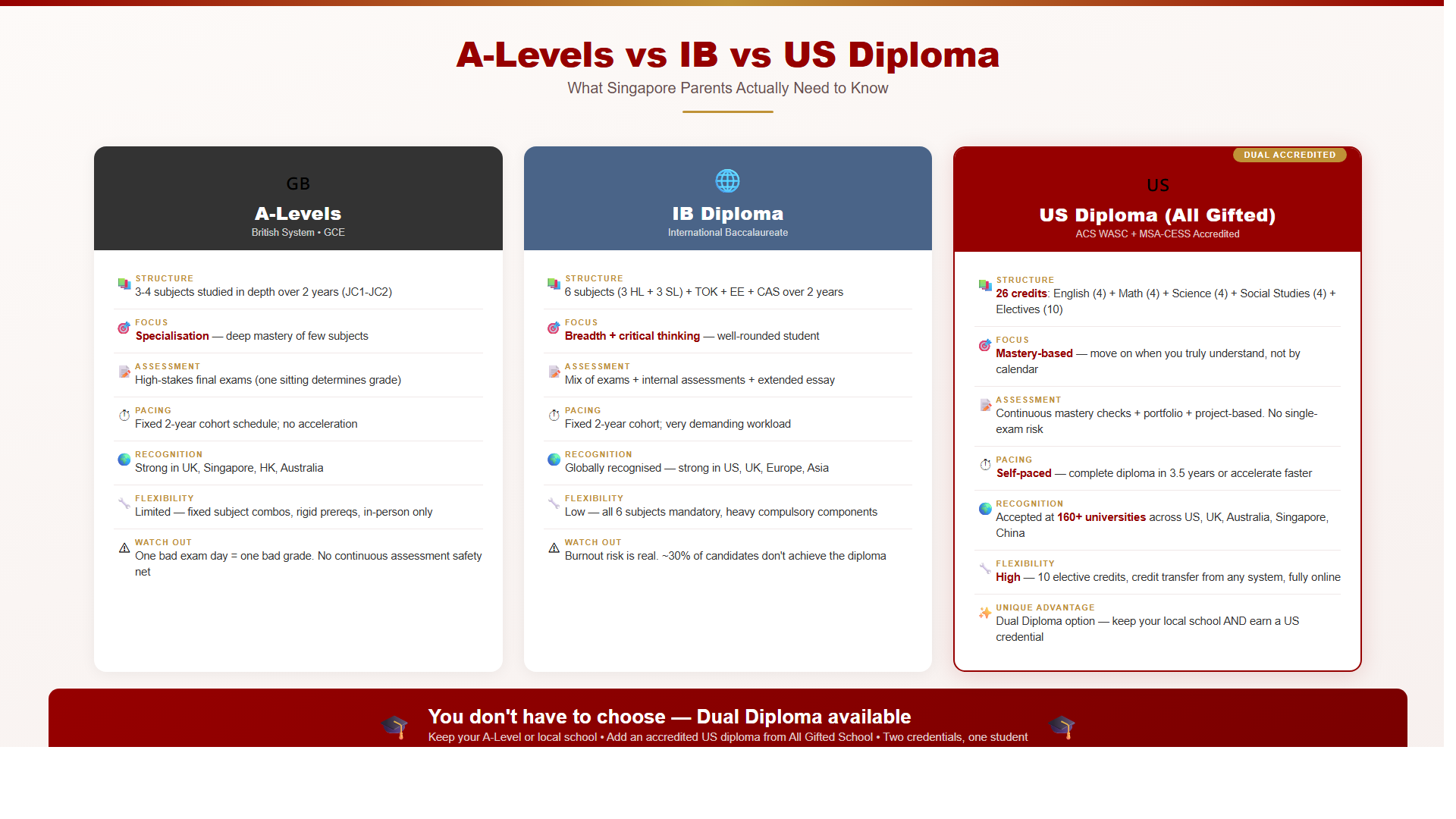
A-Levels vs IB vs US Diploma comparison infographic
A-Levels vs IB vs US Diploma — side-by-side comparison

Every year thousands of Singapore parents face the same fork in the road: A-Levels, IB, or something else entirely? Here is what you actually need to know — without the marketing spin.

A-Levels: Deep but Narrow

The GCE A-Level system, delivered through Singapore’s Junior Colleges, asks students to specialise early. You pick 3–4 subjects and study them in depth over two years. The payoff is genuine mastery in those subjects. The risk is real: your entire grade rests on a single exam sitting. One bad day, one bad result.

A-Levels are well recognised in the UK, Singapore, Hong Kong, and Australia. But flexibility is limited — fixed subject combinations, rigid prerequisites, and in-person attendance only.

IB Diploma: Broad but Brutal

The International Baccalaureate takes the opposite approach: breadth. Six subjects (three at Higher Level, three at Standard Level), plus Theory of Knowledge, an Extended Essay, and CAS (Creativity, Activity, Service). It produces well-rounded thinkers and is globally recognised.

The catch? The workload is punishing. Around 30% of candidates globally do not achieve the full diploma. Burnout among IB students is well documented. And there is zero flexibility in the programme structure — all six subjects and all compulsory components are mandatory.

US Diploma (All Gifted School): Flexible and Accredited

The US high school diploma system works differently from both A-Levels and IB. At All Gifted School, students complete 26 credits across English (4), Mathematics (4), Science (4), Social Studies (4), and Electives (10). The programme is accredited by both ACS WASC and MSA-CESS — dual accreditation that is recognised worldwide.

Three things set this apart:

  • Mastery-based pacing: Students move forward when they genuinely understand, not when the calendar says so. The diploma can be completed in as little as 3.5 years — or faster for students who are ready.
  • Continuous assessment: No single high-stakes exam determines your future. Assessment is ongoing through mastery checks, portfolios, and projects.
  • Credit transfer: Students coming from any system — A-Levels, IB, IGCSE, local curricula — can transfer existing credits and complete only what remains.

Graduates have been accepted at over 160 universities across the US, UK, Australia, Singapore, and China.

You Don’t Have to Choose

Here is what most parents don’t realise: you do not have to pick one or the other. All Gifted School offers a Dual Diploma option. Your child stays in their current school — JC, international school, or local school — and simultaneously earns an accredited US diploma. Two credentials. One student. No transfer required.

Ten elective credits mean students can pursue what they are genuinely interested in, not just what the syllabus dictates. The entire programme is delivered online, making it accessible from anywhere.

The Real Question

The question is not which system is “best.” The question is which system fits your child — their learning style, their pace, their goals. A child who thrives under exam pressure may do brilliantly in A-Levels. A child who wants breadth and structure may love IB. A child who needs flexibility, mastery-based progression, or a second credential has a clear pathway through All Gifted School.

If you want to explore what fits, visit allgifted.com or contact us to talk it through. No sales pitch — just clarity.

— Pamela Lim, Founder and Director, All Gifted School

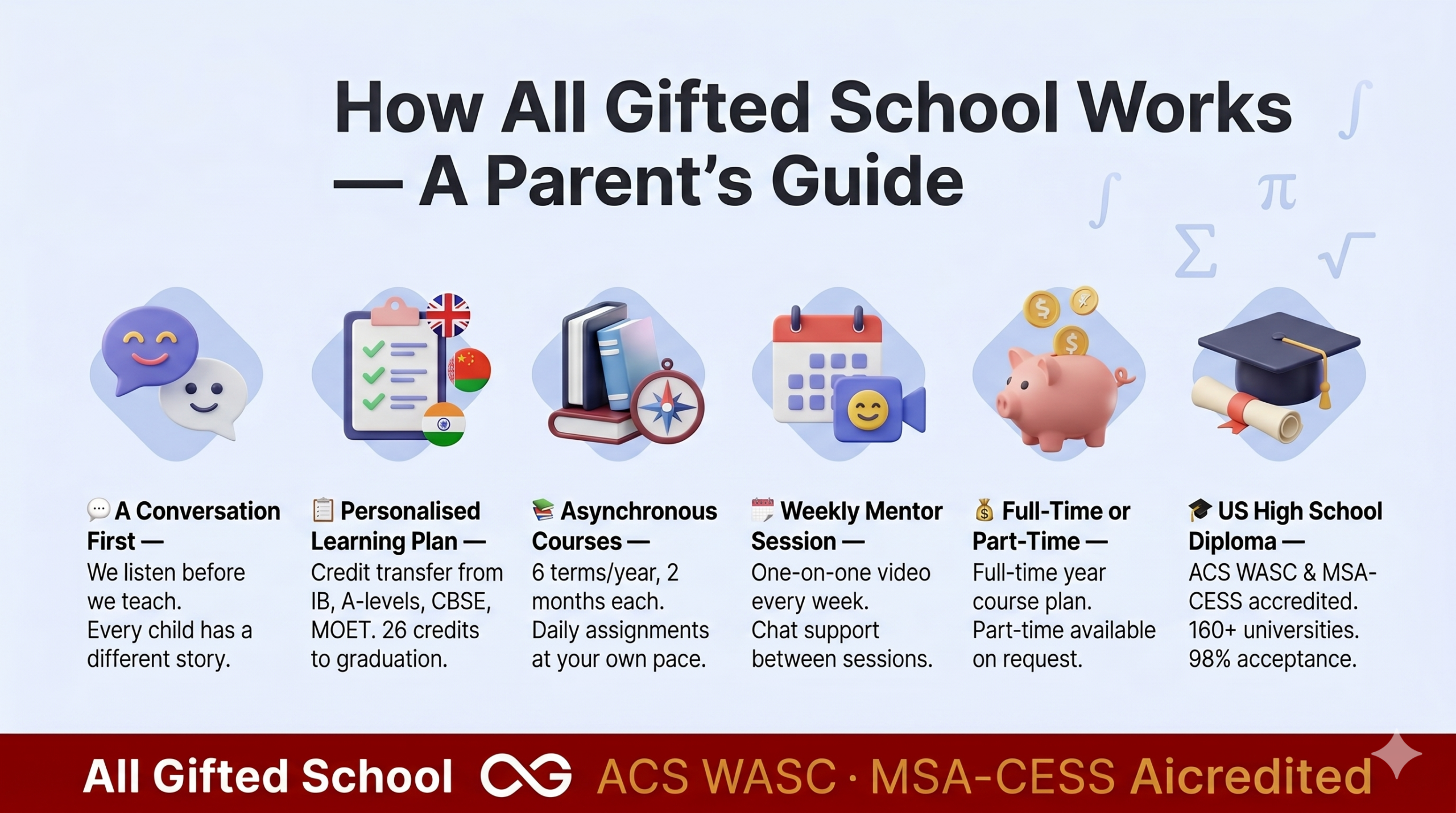
How All Gifted School Works — A Parent’s Guide

Every week, I hear the same question from parents.

“How does it actually work?”

They have heard about All Gifted. They know we are accredited. They know we are online. But they cannot quite picture how their child would spend a day, a week, a term with us.

So here is the honest answer — no marketing, no spin. Just how it works.

It starts with a conversation.

Before anything else, we talk. Not to sell. To listen.

Every child arrives at All Gifted with a different story. Some are gifted learners who have outgrown their school. Some are expat children who have moved countries three times in five years. Some are recovering from a school system that told them they were not good enough. Some are in a partner school overseas and need an accredited diploma.

We need to understand your child before we can educate them.

The guidance counsellor builds a plan.

Once we understand your child’s background, our guidance counsellor maps out a personalised learning pathway.

If your child has studied under another curriculum — A-levels, IB, CBSE, MOET, or any other — those studies may qualify for credit transfer. We evaluate prior learning and map it to equivalent US high school credits. Your child completes only the remaining credits needed. Not the full programme from scratch.

If your child is starting fresh, we build a full course plan leading to the 26 credits required for graduation.

How courses work.

All Gifted runs six terms per school year. Each term lasts two months.

Courses are asynchronous. Your child does not log in at a specific time. Instead, they complete daily assignments and engage with course material at their own pace. This is not a free-for-all — there is structure, deadlines, and accountability.

Every student has a dedicated mentor. Once a week, they meet one-on-one over video. The mentor reviews progress, answers questions, provides feedback, and adjusts the pace if needed. Between sessions, students can reach their mentor via chat for daily support.

This is not a recorded lecture programme. It is a relationship-based education.

What a typical week looks like.

Monday to Friday, your child works through their course material — readings, assignments, projects. The workload is designed to be manageable alongside life, whether that means another school, extracurricular activities, or family commitments.

Once a week, they have their mentor session. This is the heartbeat of the programme. It is where confusion becomes clarity, where the mentor sees the child — not just their grades.

Parents receive regular updates. We believe education is a partnership between school, child, and family. You are never in the dark.

Full-time or part-time.

Full-time students take multiple courses per term and are working towards their full diploma. Part-time students may be taking one or two courses alongside another school or programme.

Full-time tuition is USD 10,000 per year for Grade 10 and below, or USD 13,000 per year for Grade 11 and above. Part-time is USD 1,300 per course.

What your child graduates with.

A US High School Diploma from All Gifted School — accredited by ACS WASC and MSA-CESS. This is recognised for university entry in Singapore, Australia, the United States, China, Hong Kong, the UK, and beyond.

98% of graduates across the All Gifted system have been accepted to university. Our students have been admitted to more than 160 universities worldwide, including MIT, UC Berkeley, NTU, University of Sydney, and CUHK.

Blended mode — through partner schools.

If your child prefers a physical learning environment, we work with partner schools across Asia. The partner school provides the campus, community, and pastoral care. All Gifted provides the internationally accredited curriculum, mentors, and diplomas.

Your child gets the best of both worlds — face-to-face community and world-class online curriculum.

If you are interested in the blended mode, contact us — we will help you find a suitable partner school in your area.

The bottom line.

All Gifted is not a typical online school. We do not dump content on a screen and hope for the best. Every child has a mentor. Every family is a partner. Every pathway is personalised.

If you want to understand whether All Gifted is right for your child, the best next step is a conversation. Reach out to us. We respond to every family personally.

Teaching Kids to Be Human Again

She was upset. A saleslady at a beauty counter told my student she had oily skin and needed a whole range of products to fix it.

I had sent my students out to make life difficult for staff — McDonald’s, retail shops, beauty counters around our Bras Basah campus in SMU. I wanted them to learn about customer service as part of the entrepreneurship course. When she came back, she wasn’t thinking about sales techniques. Someone had looked at her face and told her something was wrong with it. She was thinking about buying that skin care.

She learned a sales tactic: instill fear, uncertainty and doubt. So did my whole class. I call it FUD.

This is the opposite of what we did for over a century. We built schools for the factory line. Sit still, memorise, reproduce, don’t ask questions. We trained children to behave like machines — predictable, obedient, efficient. It worked because the factories needed that.

Today, we have actual machines, and they are better at being machines than we ever were. AI writes cleaner essays, calculates faster, never calls in sick. So the question flips — not “how do we make humans more productive?” but “what makes a human human?”

Not the mechanics of calculus — we ought to teach the instinct to ask whether the answer makes sense. Not grammar rules, but the courage to say something worth reading. Not how to pass an interview, but how to walk away from a job that’s wrong for you. Not how to analyse a case study, but how to sit across from someone and know they’re lying.

No system teaches this well. And honestly, by the time any formal system overhauls itself to try, it will be too late. Curriculum committees, government policies and certification bodies move in years, decades and sometimes centuries. AI moves in days. Our children do not have time to wait for the syllabus to catch up.

So families must step in. We must teach our kids how to be human, because only humans can do that. Not by lecturing them about empathy or critical thinking — those are just more school words. But by dragging them into real situations with real stakes and letting them feel their way through. On a daily basis.

That student — I told her I have oily skin too, and that’s what keeps you looking younger. The saleslady was trying to fix the one thing that didn’t need fixing.

That was almost 20 years ago. By now, she must be so happy she has oilier skin that doesn’t age easily.

Why Do I Have to Study This?

Today’s five-year-olds may never need to get a job.

That’s what Vinod Khosla said.

Not because they are lazy.
Because AI will do most of what we call “work.”

If that is true… what exactly are we preparing our children for?

“Why do I have to learn this?”

It started when he was 14.

The Youngest One looked up from his homework and asked, “Why do I have to study calculus? I’m never going to use this.”

I gave the standard answer. Discipline. Problem-solving. Keeping options open.

He wasn’t convinced.

From that day on, everything became a question.

Why memorise the periodic table when you can look it up in seconds?
Why write essays in rigid formats?
Why spend hours proving things when you want to build things?

I realised I didn’t have answers.
Only inherited ones.

Nothing has changed.

We still drill them on content.
Still measure them the same way.

In Asia, we push even harder.
More tuition. More pressure.
All to master things we already know they will never need.

This is not new.

Ken Robinson said it years ago: schools kill creativity.
Systematically.
They reward conformity.
They train children to give the “right” answer.
They strip away the one thing that may actually matter now.

Because in a world where AI generates answers and outperforms humans in routine work…
Creativity is not optional.
It is survival.

Work hard vs. Play hard.

We were taught to work hard and study hard to ace exams.
That made sense in the industrial age.
It does not make sense now.

Because in the AI and robotics age, it will not be those who work hard who win.
It will be those who know themselves… and know how to play hard.
To explore deeply.
To pursue what draws them.
To build something because they care, not because they are told.

If we force our children to trade away the time to discover who they are… what they enjoy… what they are capable of… for better grades and careers that may not even exist…
then we are not preparing them.
We are training them to ignore themselves.

The plot twist.

Now here is the part most people don’t expect.

That Youngest One graduated in computer science. High distinction. Including calculus.

And no, he does not use calculus.
AI handles that instantly.

What he uses is something else.
The ability to sit with complexity.
Break down unfamiliar problems.
Tolerate not knowing.
Push through confusion until things make sense.

The content was mostly irrelevant.
The process was everything.

The system is broken.

The current education system was designed for factories.
Compliant. Punctual. Repetitive.
That world is gone.
AI and robotics are here.
Education will have to fundamentally change.

But this is not like previous shifts.

When computers arrived, we taught computer literacy.
When the internet arrived, we taught digital skills.
We assumed the answer was to teach people how to use the new tools.

This time is different.

It is not about teaching our children how to write better prompts.
Or how to use AI tools.
Or how to automate workflows, build copilots, or deploy models.
Machines will do all of that better, faster, and at scale.

This time, the shift is not about integrating humans into technology.
It is about integrating technology into humans.
How they think. How they learn. How they decide what matters.

Because when intelligence is abundant, the only scarce resource is direction.

Individualised learning is already here.

The internet has already made individualised learning possible.
Every child can now learn differently, at their own pace, towards their own potential.

Some parents understand this.
They raise children who think, build, question, and adapt.

Others still chase grades and certificates as if the rules haven’t changed.

The real question.

So here is the real question.

Are you still optimising your child for a system that is disappearing… while that same system is quietly, irreversibly training out the one thing they may actually need to survive?

Because if you get this wrong, you don’t get a second chance.
You cannot redo your child’s education.
You cannot give back those years.

No parent should outsource this responsibility.
Not to schools. Not to tuition centres.
Not to a system that has already failed to change.

Because at the end of the day, it is not the school that will live with the consequences.
It is your child. And it is you.

Because once creativity is trained out of them…
no amount of grades will bring it back.

Full circle.

Let’s go back to the beginning.

If Vinod Khosla is right, and today’s five-year-olds may never need a job…
then everything we are doing right now needs to be questioned.

What exactly are we preparing our children for?


Pamela is the founder of All Gifted School where we have placed 98% of our students into their dream universities and courses (with and without scholarships) in the US, Australia, Singapore, Hong Kong and China. At All Gifted, we prepare students not just for a career, but for a lifetime of careers of their choice, including careers that do not yet exist. Because in a world where work is no longer guaranteed… the ability to choose what to pursue, and pursue it fully, is.

If you want to understand what that means for your child, watch out for our next seminar. We will show you what we have learned. Or you can continue as you are… and hope you are not catastrophically wrong.

The Child the System Left Behind — Now Leads the Research That Changes It

There is a particular kind of irony in the story of All Gifted School.

We were founded for the child the system left behind. The child labelled difficult, slow, or simply different. The child who did not fit the mould that a century of industrial education had carefully constructed.

And now, one of our own researchers — in her early twenties — has just been recognised by one of the world’s most prestigious organisations in gifted education.

The Mensa Foundation has awarded Dr. Sue-Ann Lim its Award for Excellence in Research for the 2023–2024 cycle.

She is, to our knowledge, one of the youngest recipients this award has ever had.

What the research says

Dr. Lim’s paper — “Effectiveness of Invention Tasks and Explicit Instruction in Preparing Intellectually Gifted Adolescents for Learning” — was published in Instructional Science, one of the most respected peer-reviewed journals in the field of educational research. It was co-authored with Professor Jae Yup Jung and Professor Slava Kalyuga of UNSW Sydney.

The study investigated something that sits at the heart of everything we do at All Gifted:

How do gifted children actually learn best?

Not how the system assumes they learn. Not how we wish they learned. How they actually do.

The findings were striking. Gifted adolescents performed significantly better in far-transfer tasks — the ability to apply knowledge in new and unfamiliar situations — when they were first given open-ended problem-solving tasks before receiving direct instruction.

In other words: let them struggle with the problem first. Then teach.

This is the opposite of how most schools operate. Most schools instruct first, then test. The gifted child — who already processes faster, connects dots earlier, and sees patterns the curriculum hasn’t introduced yet — is bored before the lesson begins.

Dr. Lim’s research gives us a scientific foundation for what many great educators have always known intuitively: gifted children do not need protection from difficulty. They need meaningful difficulty. The right kind. At the right moment.

Why this matters for All Gifted

At All Gifted School, we have always believed that giftedness is not a single thing. It is not a test score. It is not an IQ number. It is a way of engaging with the world — curious, persistent, hungry for challenge, and often deeply frustrated by environments that were not built for them.

Dr. Lim’s research validates the pedagogical foundation of how we teach. Our individually paced model — where students move through material at their own speed, guided by a dedicated mentor — creates exactly the conditions her research identifies as optimal for gifted learners.

There is no waiting for the class to catch up. There is no moving forward before understanding is deep. There is no one-size-fits-all lesson plan designed for the average child who, as Dr. Lim’s research implicitly reminds us, is not the child sitting in front of you.

A personal note

When I founded All Gifted in 2014, I did so because of my own children — and because of the thousands of families I had worked with as a career counsellor at Singapore Management University who arrived at university having chosen the wrong path, having been pushed through a system that never asked who they really were.

Seeing Dr. Lim receive this recognition fills me with a specific kind of pride — not just institutional pride, but the pride of proof.

Proof that when you build an environment around the child rather than around the system, extraordinary things happen.

She was in her early twenties when she conducted this research. She was doing what gifted children do when given the right environment: she flew.

That is All Gifted.

The award

The Mensa Foundation’s Award for Excellence in Research recognises groundbreaking published investigations in the disciplines of intelligence or intellectual giftedness. Recipients are drawn from the fields of education, psychology, sociology, neurology, and related disciplines worldwide.

Dr. Lim’s paper was published in Instructional Science (Springer Nature, 2023).

Mensa Foundation Awards for Excellence in Research →


All Gifted School is a Singapore-founded international online school for Grade 6–12, accredited by ACS WASC and MSA-CESS. We were built for the child the system left behind.

If you have a gifted child — or a child who has been labelled, overlooked, or simply not yet seen — talk to us.

Don’t Let AI Empty Your Students

I picked up his GP essay this week, hoping to see a shift.

Last week, he had promised me he would try. No more outsourcing everything to AI. Try to think it through first. Try to struggle a little.

But as I read the first paragraph, I already knew.

The structure was too neat. The phrasing too familiar. The arguments perfectly balanced, but somehow going nowhere. When I asked him about it, he said he wrote it himself. Then hesitated. Then admitted he had “just used a bit of help.”

I did not need the admission.

I have been picking up essays for thirty years. I know what thinking looks like on a page. And I know what the absence of thinking looks like.

Emails from people I used to recognise. Polished, structured, grammatically perfect, and strangely empty. You can tell when no real thinking has taken place. Even adults are doing this now. Producing more than ever before, but saying less.

AI is powerful. It should be used. It sharpens language, fixes structure, and can even push thinking further.

And we must not take it away from our students. This is their future.

But we are now walking a very fine line.

If they start outsourcing their thinking before they have built it, we are not accelerating them. We are emptying them.

Twelve years ago, I started All Gifted on a simple belief: that all children are gifted. Over the years, we saw children who did not fit into elite systems thrive when given the right environment. We saw students once destined for vocational routes pursue their dream of becoming doctors. We saw school refusal cases return, and eventually step into universities, joining choirs and bands, finding their place again.

We built around the child.

Now, we must do the same with AI.

At All Gifted, we are changing the way we teach. We are moving from serving digital natives to serving AI natives — children who will never know a world without artificial intelligence.

We recently visited China to study how the country intends to integrate AI into learning. We are in conversation with partners in this space and hope to bring these new approaches to our students in the near future.

We must integrate AI deeply into how they learn. Teach them to use it, question it, direct it.

But never let it replace them.

Because AI is not the differentiator.
The human behind it is.

If we cannot help our students find their voice, their thinking, their way of seeing the world — then there is nothing for AI to extend.

They will not lose to AI.

They will lose to the quiet kid in the back who used AI to check his logic, but kept his soul.

She Graduated a Year Early. Now She’s Joining Her Brother at Monash.

Kate had a goal: graduate before her peers.

All Gifted School was built for exactly that — students who are ready to move faster and should not have to wait for the system to catch up with them.

“Kate will be joining her brother at Monash University this year, and we could not be more thrilled. What makes this even more special is that Kate is graduating from AGS a full year earlier than her peers in her Singapore school. That kind of acceleration is remarkable, and AGS made it possible.”

Kate’s mother, Teresa L., is clear that the result belongs equally to her daughter and to the mentors who guided her.

“Of course, I cannot discount Kate’s own hard work and determination — she put in real effort every single day. But the support from her mentors at AGS was equally important. They guided her, encouraged her, and helped her stay on track to reach this goal.”

Now Kate and her brother will both be at Monash — a family achievement that started with a decision to do education differently.

“To any parent wondering whether AGS can truly deliver — for us, the answer is a resounding yes.”

— Teresa L., Parent of Kate, Singapore

Megan’s Anxiety Was Real. All Gifted School Gave Her Space to Breathe.

Katherine K. made a difficult decision.

Her daughter Megan had completed Primary 6 and started local secondary school. Within a year, the stress was visible — anxiety that was affecting her mental health, her motivation, and her sense of herself.

“My daughter Megan joined All Gifted School after completing Primary 6. She had struggled with stress and anxiety during her first year in a local secondary school, and I made the decision to find a different path for her. It was not an easy call, but it is one I am deeply glad I made.”

At All Gifted School, the structure was gentler. The environment was supportive. The mentors took the time to know Megan as a person.

“Megan’s mental health improved significantly once she settled into the AGS system. The structure was gentler on her, the environment was supportive, and her mentors were consistently kind and thoughtful in the way they engaged with her.”

Mr. Paul became a steadying presence in her week.

“The warmth and encouragement that Mr. Paul in particular showed Megan made a real difference to her motivation. She would genuinely look forward to her weekly Zoom meetings with him — that says everything.”

Megan worked hard. And AGS gave her the space to do it at her pace, without the pressure that had been crushing her.

“Megan is a conscientious and hardworking girl, and AGS gave her the space to flourish at her own pace. She will be heading to Australia for university soon, and I thank All Gifted School from the bottom of my heart for guiding her through these years.”

— Katherine K., Parent of Megan, Singapore

My IGCSE Results Were Not What I Hoped For. All Gifted Gave Me a Second Chance.

Saisha D. had hoped for different IGCSE results.

When they came in below expectations, the path forward felt uncertain. Her confidence — and her sense of what she was capable of — took a serious hit.

“My IGCSE results were not what I had hoped for, and for a time I was unsure what my path forward looked like. All Gifted School gave me a second chance — and I am determined not to waste it.”

At AGS, there are no labels. No permanent records that define what you are capable of. Just the chance to start again, at your own pace, in your own way.

“Since joining AGS, I have been doing well and, more importantly, I have found my confidence again. I know now that I am capable of graduating successfully and going abroad for my university studies.”

Sometimes the most important thing a school can do is simply believe in a student when they have stopped believing in themselves.

“Sometimes all you need is someone who believes you can do it. AGS was that for me.”

— Saisha D., Student


We don’t spam! Read more in our privacy policy