Posts Tagged ‘education’

The AI Flux

Why the influencers urging us to learn AI in five days are actually drifting with it — and what doesn’t move under your feet.


I get sent these constantly. The reels, the carousels, the threads. An influencer telling me to get off social media and spend the next five days learning AI. Then another. Then another.

They are telling me this on social media.

For a while I tried to follow them. One course, then the next. A new framework. A new tool. A new “must-watch” five-hour playlist. The output went up. I built workflows. I shipped things faster than I had before. Measurably faster. There was real productivity gain.

But somewhere in the third or fourth round, something else set in. Not just fatigue.

The pace was not the problem

The companies these influencers were pointing me at were outdoing each other in a matter of days. The influencers themselves were learning at neckbreaking pace, saying the same thing in different ways, or different things in the same ways. The volume was enormous. The signal was unstable.

Every week brought a new agent framework, a new model release, a new “this changes everything” announcement. Every course I had taken last quarter referenced a tool that had been deprecated, redesigned, or absorbed into something larger. Every workflow I had built required maintenance just to keep functioning, let alone to incorporate the new capabilities I was supposed to be learning about.

I was running faster and arriving at the same place.

There is a name for this

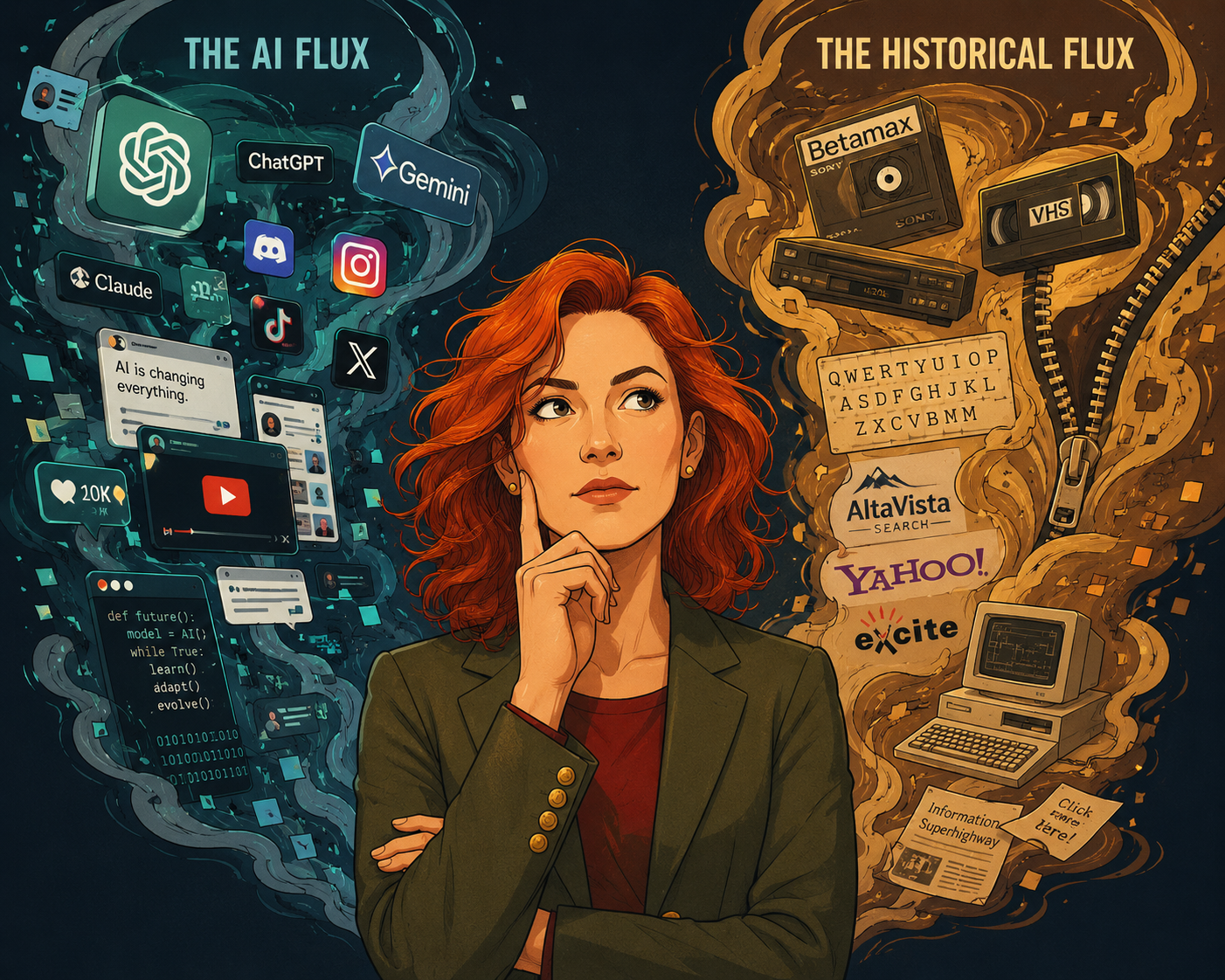
Utterback and Abernathy, in their work on industry dynamics, called it the fluid phase. I used to teach it at Singapore Management University, where I called it the period of flux. It is the stage every major technology passes through before a dominant design emerges, before any standard crystallises, before the market has decided what the technology actually is.

In the fluid phase, competition is on functionality rather than cost. Entry is easy. Failure rates are high. Many designs compete; most disappear. The phase ends when one design — usually not the technically best, but the one that captures the network — becomes the standard. From that moment forward, the industry shifts into incremental refinement.

QWERTY beat Dvorak. VHS beat Betamax. The iPhone form factor beat everything else. None of those outcomes were obvious during the fluid phase.

AI is in the fluid phase now.

The transformer architecture is settled at the model layer, but everything above it is contested. Agent frameworks, application interfaces, deployment topologies, evaluation methods, pricing models, regulatory regimes, even the question of what an “AI product” is — all in active experimentation. There is no QWERTY for AI yet.

This explains the noise

This is why so many companies exist. This is why they outdo each other every week. This is why influencers proliferate. There is no settled answer for them to converge on, so they generate variants — some useful, most noise.

It is also why what you learn in five days may be useless in a few months. Tools will be replaced. Frameworks will be rewritten. The agent stack you built workflows on top of last quarter has competitors this quarter that work on different principles. Anyone selling you a fixed curriculum on a moving target is selling you yesterday’s snapshot.

This is not a failure of effort. It is structural. No five-day course can teach a technology that will reorganise itself before the course is over.

The deeper danger is the drift

But the pace, exhausting as it is, is not the real problem. The real problem is the drift.

AI drift cuts in two directions.

The AI itself drifts. Models change. Capabilities shift. The behaviour of the same prompt is not the same six months apart. What you taught yourself to do with last quarter’s tool no longer works the same way with this quarter’s. Fine. That is the technology, and the technology is what it is.

The human drifts too. This is the danger no one is naming.

After enough rounds of letting the model finish your sentences, your sentences start to sound like the model’s. After enough rounds of accepting the first plausible output, you stop noticing what is wrong with it. After enough rounds of optimising for the prompt that gets the result, you forget what the question was. Your judgment bends toward the tool. Your voice homogenises. Your attention shortens. Your originality, the strange and idiosyncratic angle that was yours alone, gets sanded down by repeated contact with statistical averages.

You become slightly more productive. You also become slightly less yourself.

Two drifts compounding against each other. A moving target tracked by a deteriorating compass. The technology won’t sit still long enough for you to learn it. You won’t sit still long enough to remember what you used to think. After eighteen months of this, you have shipped a great deal and become someone you do not quite recognise.

So what is the alternative?

Anchoring.

There are capacities that do not drift because they are not built on any particular model. They predate AI. They will outlast whichever architecture wins. They compound across every shift because they were never tied to one.

Reading deeply. Not summaries. Not threads. The actual book, with the actual difficulty, at the pace the writer intended.

Writing your own first drafts. Whatever you finally show the model, get something on the page first that is unmistakably yours. The drafts you let the model write for you are drafts you do not learn from.

Building one thing carefully instead of skimming twenty. Depth in any one domain — even an unfashionable one — produces judgment that cross-applies. Skimming twenty produces nothing that cross-applies to anything.

Defending your own ideas against your own scrutiny before any model sees them. The model will not push back on you in the way a serious mind would. You have to be that mind for yourself first.

These are slow. They are not five-day skills. They are not even five-month skills. They are the slow-built capacities that make you ready for whichever dominant design eventually wins — and that keep your judgment, your voice, and your attention intact while you wait to find out which one it is.

The inversion

Get off social media. Yes.

But not to learn AI in five days.

Get off to rebuild the attention span you will need to navigate a decade of flux. To recover the depth of thought that the fluid phase rewards. To keep from drifting with the very technology you are trying to learn.

The five-day course is the opposite of what the moment requires.

The moment requires the discipline of staying yourself while the ground moves.

How the pandemic forced us to relook education

[vc_row type=”in_container” full_screen_row_position=”middle” column_margin=”default” column_direction=”default” column_direction_tablet=”default” column_direction_phone=”default” scene_position=”center” text_color=”dark” text_align=”left” row_border_radius=”none” row_border_radius_applies=”bg” overlay_strength=”0.3″ gradient_direction=”left_to_right” shape_divider_position=”bottom” bg_image_animation=”none”][vc_column column_padding=”no-extra-padding” column_padding_tablet=”inherit” column_padding_phone=”inherit” column_padding_position=”all” background_color_opacity=”1″ background_hover_color_opacity=”1″ column_shadow=”none” column_border_radius=”none” column_link_target=”_self” gradient_direction=”left_to_right” overlay_strength=”0.3″ width=”1/1″ tablet_width_inherit=”default” tablet_text_alignment=”default” phone_text_alignment=”default” column_border_width=”none” column_border_style=”solid” bg_image_animation=”none”][vc_column_text]Prior to the pandemic, it seemed that the epitome of a good education was only found in elite schools, augmented by endless after-school enrichment, tuition and supplementary classes. Many parents believed that the more their children left their homes for academic pursuits, the better their chances of doing well in school.

The Pandemic

Then Covid-19 hit, and everybody had to stay home. Most schools deployed off-the-shelf learning management systems that dispensed homework as a stop-gap measure.

Under pressure, teachers were forced to slap together Zoom and video classes quickly, delivered in formats they were neither familiar nor comfortable with. Commercial entities took the opportunity to launch sometimes half-baked online learning platforms, mostly in the form of video conferencing. There were also horror stories of hackers entering kids’ classrooms to wreak havoc. Parents started to question if this was the kind of education that would help their children ace the school system.

Outdated School Systems

But even before 2020, there were already rumblings that school systems were no longer relevant. Many of us know that the current K to 12 (kindergarten to Grade 12) compulsory education system is outdated. It started in Prussia in 1800, borne out of the need to have a large workforce during the industrialisation age. While mass education has reduced illiteracy and benefited billions of people, it is still a 200-year-old system that has failed to keep up with the times.

The traditional school system, where the teacher acted as the sage on stage dispensing knowledge worked wonders for my generation, but why should it be effective for digital natives born after 1999? They found their own alternatives to the 45-minute-lecture – a two-minute-Youtube video made by a world-class instructor, played at 1.8xnormal speed.

Alternative Paths and Individualised Education

Technology and alternative ideas have been seeping into our mass education system, along with the recognition that the era of mass education is over. Covid-19 signals it is time to embark on individualised education.

As a mother of five, I’ve learnt education is not what our children can get out of schools; rather, education is what I can put into a child. To put the right education into my child, I need to first spend time to understand his or her passions, gifts and learning styles. Most people like to work on what they are good at, so I spend time to observe what my kids want to work on, and then find resources to bring them up to their fullest potential, while levelling them up in areas they are weak in. The main objective is to build up their self-esteem and confidence by allowing them to excel at things they love.

I loved teaching my own children. From learning how to model math questions to taking courses to update my computer programming skills, I found myself constantly upgrading just to participate in my kids’ education actively. No matter which stage of their education, our home has been the most important learning venue for my family.

Not everybody agrees with my approach. But it has always puzzled me. Why spend time trying to ace a system when I can use that time to give my children a great education?

The Changing Playing Field

Covid-19 has started us off with the great home-based learning experiment. However, to fully harness the strength of home-based learning, instructional design must not only leverage technology to fully integrate with school-based learning, it must also fully involve parents, educators and peers.

For starters, parents must get involved. First, with kids studying at home, we can observe their learning styles and provide valuable insights to their teachers. Second, we can acquire free and paid resources to activate better learning. Students can now work on the topics in which they are most passionate, at the level they are most comfortable. Don’t be afraid to go for materials that are beyond your child’s level according to the school curriculum.

Besides instructor-led activities, I like to provide opportunities for students to do research and self-study at their own pace, as well as engage their peers to learn how to negotiate, follow and lead. I also  give them  time and space to reflect on lessons.

All of my children earned their bachelor degrees before they turned 18. More interestingly, at the  online international school, which I started in 2015I have  managed to radically accelerate about 300 students from Singapore, Malaysia, Australia, Indonesia, Hong Kong and China with different capabilities, from those with learning disabilities or who were streamed into Normal Tech at PSLE, to those who are exceptionally gifted.

As always for me, it is not about how much students achieve academically, but how happy they are in the process that counts.
[/vc_column_text][/vc_column][/vc_row][vc_row type=”in_container” full_screen_row_position=”middle” column_margin=”default” column_direction=”default” column_direction_tablet=”default” column_direction_phone=”default” scene_position=”center” text_color=”dark” text_align=”left” row_border_radius=”none” row_border_radius_applies=”bg” overlay_strength=”0.3″ gradient_direction=”left_to_right” shape_divider_position=”bottom” bg_image_animation=”none”][vc_column column_padding=”no-extra-padding” column_padding_tablet=”inherit” column_padding_phone=”inherit” column_padding_position=”all” background_color_opacity=”1″ background_hover_color_opacity=”1″ column_shadow=”none” column_border_radius=”none” column_link_target=”_self” gradient_direction=”left_to_right” overlay_strength=”0.3″ width=”1/1″ tablet_width_inherit=”default” tablet_text_alignment=”default” phone_text_alignment=”default” column_border_width=”none” column_border_style=”solid” bg_image_animation=”none”][image_with_animation image_url=”17737″ animation=”Fade In” hover_animation=”none” alignment=”” border_radius=”none” box_shadow=”none” image_loading=”default” max_width=”100%” max_width_mobile=”default”][/vc_column][/vc_row]


We don’t spam! Read more in our privacy policy