[vc_row type=”full_width_background” full_screen_row_position=”middle” column_margin=”default” column_direction=”default” column_direction_tablet=”default” column_direction_phone=”default” bg_color=”#f4f4f4″ scene_position=”center” top_padding=”10%” bottom_padding=”10%” text_color=”dark” text_align=”left” row_border_radius=”none” row_border_radius_applies=”bg” overlay_strength=”0.3″ gradient_direction=”left_to_right” shape_divider_position=”bottom” bg_image_animation=”none”][vc_column column_padding=”no-extra-padding” column_padding_tablet=”inherit” column_padding_phone=”inherit” column_padding_position=”all” background_color_opacity=”1″ background_hover_color_opacity=”1″ column_shadow=”none” column_border_radius=”none” column_link_target=”_self” gradient_direction=”left_to_right” overlay_strength=”0.3″ width=”5/12″ tablet_width_inherit=”default” tablet_text_alignment=”default” phone_text_alignment=”default” column_border_width=”none” column_border_style=”solid” bg_image_animation=”none” offset=”vc_col-xs-12″][vc_column_text max_width=”450″]
Importance of Diagnostic Tests
[/vc_column_text][vc_column_text css=”.vc_custom_1600425000467{margin-top: 25px !important;padding-right: 15% !important;}” max_width=”500″]Unlike standardized tests, diagnostic tests are criterion referenced. This means that the test items and goals are determined according to a fixed set of requirements. All Gifted’s Math diagnostic test is scored on our proprietary system and measures only the student’s own performance regarding standard academic requirements.[/vc_column_text][/vc_column][vc_column column_padding=”no-extra-padding” column_padding_tablet=”inherit” column_padding_phone=”inherit” column_padding_position=”all” background_color_opacity=”1″ background_hover_color_opacity=”1″ column_shadow=”none” column_border_radius=”none” column_link_target=”_self” gradient_direction=”left_to_right” overlay_strength=”0.3″ width=”7/12″ tablet_width_inherit=”default” tablet_text_alignment=”default” phone_text_alignment=”default” column_border_width=”none” column_border_style=”solid” bg_image_animation=”none” offset=”vc_col-xs-12″][vc_row_inner equal_height=”yes” content_placement=”bottom” column_margin=”none” column_direction=”default” column_direction_tablet=”default” column_direction_phone=”default” text_align=”left”][vc_column_inner column_padding=”padding-7-percent” column_padding_tablet=”inherit” column_padding_phone=”inherit” column_padding_position=”top” background_color=”#417e94″ background_color_opacity=”1″ background_hover_color_opacity=”1″ font_color=”#ffffff” column_shadow=”none” column_border_radius=”none” column_link_target=”_self” gradient_direction=”left_to_right” overlay_strength=”0.3″ width=”1/3″ tablet_width_inherit=”default” column_border_width=”none” column_border_style=”solid” bg_image_animation=”none” enable_animation=”true” animation=”grow-in”][divider line_type=”No Line” custom_height=”85″][vc_column_text css=”.vc_custom_1600398455296{padding-right: 25px !important;padding-bottom: 25px !important;padding-left: 25px !important;}”]Identifies student’s learning problems[/vc_column_text][/vc_column_inner][vc_column_inner column_padding=”padding-7-percent” column_padding_tablet=”inherit” column_padding_phone=”inherit” column_padding_position=”top” background_color=”#960000″ background_color_opacity=”1″ background_hover_color_opacity=”1″ font_color=”#ffffff” column_shadow=”none” column_border_radius=”none” column_link_target=”_self” gradient_direction=”left_to_right” overlay_strength=”0.3″ width=”1/3″ tablet_width_inherit=”default” column_border_width=”none” column_border_style=”solid” bg_image_animation=”none” enable_animation=”true” animation=”grow-in” delay=”200″][divider line_type=”No Line” custom_height=”85″][vc_column_text css=”.vc_custom_1600398480794{padding-right: 25px !important;padding-bottom: 25px !important;padding-left: 25px !important;}”]Identifies student’s areas of giftedness[/vc_column_text][/vc_column_inner][vc_column_inner column_padding=”padding-7-percent” column_padding_tablet=”inherit” column_padding_phone=”inherit” column_padding_position=”top” background_color=”#634f4b” background_color_opacity=”1″ background_hover_color_opacity=”1″ font_color=”#ffffff” column_shadow=”none” column_border_radius=”none” column_link_target=”_self” gradient_direction=”left_to_right” overlay_strength=”0.3″ width=”1/3″ tablet_width_inherit=”default” column_border_width=”none” column_border_style=”solid” bg_image_animation=”none” enable_animation=”true” animation=”grow-in” delay=”400″][divider line_type=”No Line” custom_height=”85″][vc_column_text css=”.vc_custom_1600425016151{padding-right: 25px !important;padding-bottom: 25px !important;padding-left: 25px !important;}”]Provides avenues for individualized curriculum planning and instruction.[/vc_column_text][/vc_column_inner][/vc_row_inner][/vc_column][/vc_row][vc_row type=”in_container” full_screen_row_position=”middle” column_margin=”default” column_direction=”default” column_direction_tablet=”default” column_direction_phone=”default” scene_position=”center” text_color=”dark” text_align=”left” row_border_radius=”none” row_border_radius_applies=”bg” overlay_strength=”0.3″ gradient_direction=”left_to_right” shape_divider_position=”bottom” bg_image_animation=”none”][vc_column column_padding=”no-extra-padding” column_padding_tablet=”inherit” column_padding_phone=”inherit” column_padding_position=”all” background_color_opacity=”1″ background_hover_color_opacity=”1″ column_shadow=”none” column_border_radius=”none” column_link_target=”_self” gradient_direction=”left_to_right” overlay_strength=”0.3″ width=”1/1″ tablet_width_inherit=”default” tablet_text_alignment=”default” phone_text_alignment=”default” column_border_width=”none” column_border_style=”solid” bg_image_animation=”none”][vc_column_text]We looked into the crystal ball eight years ago for him when he was just eight at one of our labs when I was teaching in the Singapore Management University. At that point, the only information his parents could give us about him was that he had a learning disability and was dyslexic.
Instead of more gloomy news, we had a different story to tell his mother. Our results showed him up to be gifted in Math although his had a weakness in reading. Subsequently, he was indeed tested gifted by other IQ tests that his mother brought him to.
Eight years later, Xavier is now studying is an elite school for Math and Science.
When I developed the Math diagnostic system at that time, I knew the importance of diagnostic tests. It is a window into our students’ strengths and abilities without limiting and without judging. They are unlike standardized tests or school examinations.
Diagnostic tests are the first steps towards individualizing and finding an education that is suitable for a child, by understanding the areas they are lacking in, and the areas they are doing well in.
Over the years, our system has helped thousands of students not only find their calling and potential, but more importantly, their self-esteem. It provides hope as students work on what they are good at, and when they are confident, they become good at their areas of weaknesses, too.
The following is the case study of Xavier written in 2012. Almost a decade later, we look back and are glad we knew what he was capable of and has the potential to do.[/vc_column_text][/vc_column][/vc_row][vc_row type=”in_container” full_screen_row_position=”middle” column_margin=”default” column_direction=”default” column_direction_tablet=”default” column_direction_phone=”default” bg_color=”rgba(150,0,0,0.14)” scene_position=”center” text_color=”dark” text_align=”left” row_border_radius=”none” row_border_radius_applies=”bg” color_overlay=”#ffffff” color_overlay_2=”rgba(150,0,0,0.13)” overlay_strength=”0.8″ gradient_direction=”left_b_to_right_t” shape_divider_position=”bottom” bg_image_animation=”none” shape_type=””][vc_column column_padding=”no-extra-padding” column_padding_tablet=”inherit” column_padding_phone=”inherit” column_padding_position=”all” background_color_opacity=”0.4″ background_hover_color_opacity=”0.4″ column_shadow=”none” column_border_radius=”none” column_link_target=”_self” gradient_direction=”left_to_right” overlay_strength=”0.3″ width=”1/1″ tablet_width_inherit=”default” tablet_text_alignment=”default” phone_text_alignment=”default” column_border_width=”none” column_border_style=”solid” bg_image_animation=”none”][vc_column_text]
Case Study of Xavier (Math Diagnostic Test)
(written on April 14, 2012 by Pamela Lim)
Mrs XG was reluctant to leave seven-year-old Xavier with us, as he was afraid of strangers, and that he is dyslexic. Her concerned face caught my attention, and so I went over to watch Xavier.
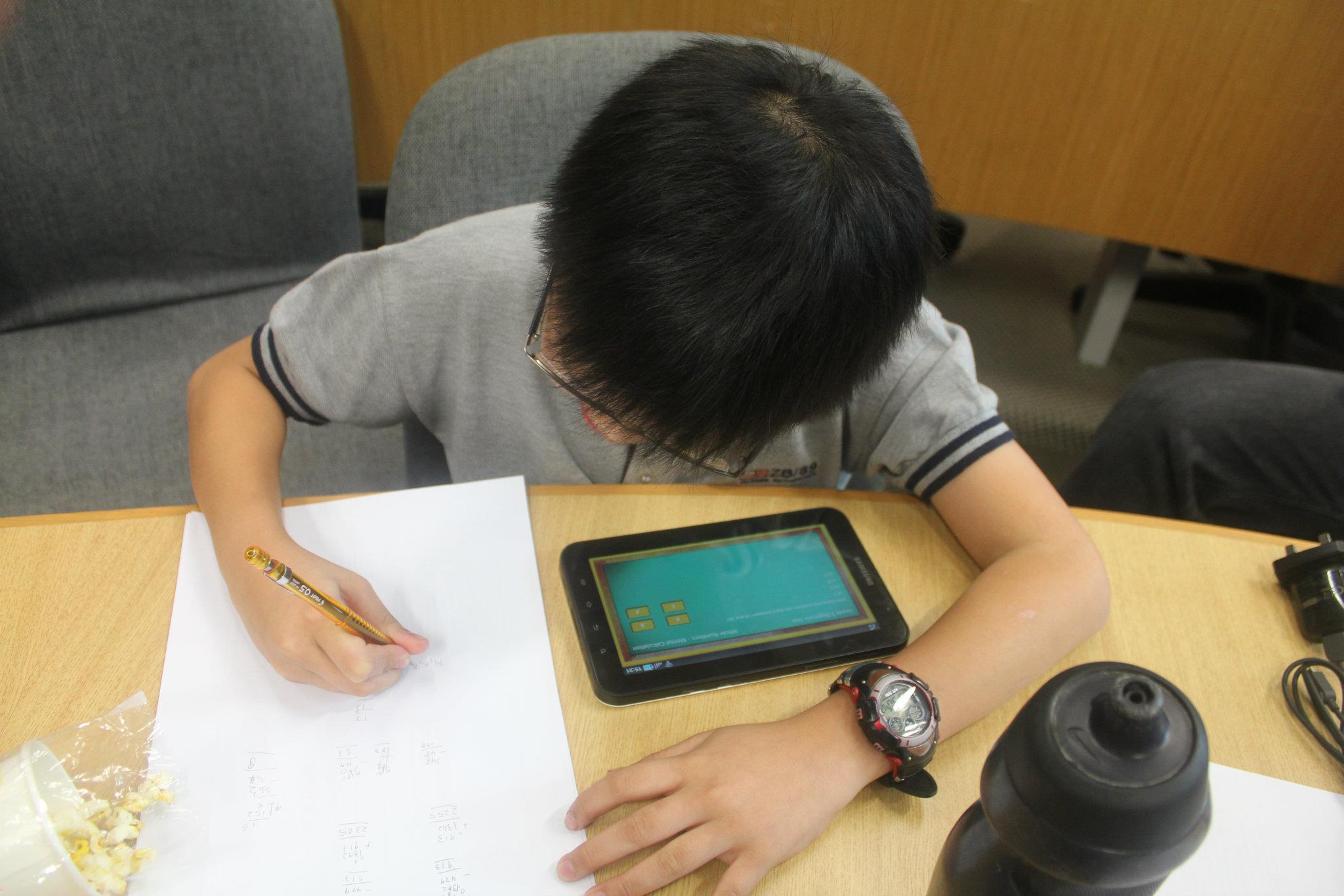
Xavier is your regular P2 boy, a little quiet and reserved perhaps, but he was not afraid of me, and I’m definitely a stranger. My team gave him some popcorn, a balloon, shared some jokes with him and soon he was on his way to do our Math Diagnostic tests.
XG is one of 20 to 30 primary school students who participated in our Math diagnostic test last month. The research, done together with colleagues and students from Singapore Management University’s Information System department, was aimed at testing the efficacy of our Math Diagnostic system, and to give insights to students and their parents of their children’s Maths ability. Our system analyses the strengths and weaknesses of each child in each of the 11 fields, hundreds of tracks and thousands of skills within our system.
The purpose of having such a system is to provide detailed information to students, educators and parents, so that they can work on students’ weaknesses and know their strengths.
Like the rest, Xavier settled into the test. So I proceeded outside the seminar room to talk to Mrs XG. Her anxiety was consistent with the thousands of parents I have met, especially those whose offsprings are diagnosed with some kind of disability in our high-performing first-world society. It seems, that most mothers become apologetic, lost and insecure once their kids are diagnosed with some learning disability.
As a mother to a special needs child, I can empathize with Mrs XG. Life of a mum with a special needs child is filled with uncertainty, especially with the world telling us how bad it can be. She talked about how she was clueless about XG’s future, him being afraid of strangers, and that school would be a torture for him. Then, in the same breath, she asked me if it was possible to accelerate him, knowing all my kids were radically accelerated. Here was a mother who was worried about her child coping, yet asking for acceleration. I thought it was quite exceptional.
Not wanting to commit or comment before seeing his results, I became really curious and checked with my team.
Interestingly, the team members were more curious about Xavier than I was. Especially on how impossibly intelligent he really is. He was just P2 (or 7+ years old) yet he cleared all the skills required to answer questions to P6 (12 year old) level, and hit the ceiling for most tests. The team did not believe his capability, especially when it was executed silently and unassumingly. He even filled out the rough paper given to him with workings.
We were stunned.
I checked his results just minutes ago, and wished I had sat next to him to watch that moment of truth. Now, I might never see it again! A boy with dyslexia but a Maths genius at the same time. While we celebrated this wonderful discovery in the boy, deep inside, I feel a little worried for the boy.
How is he going to survive the education system that chooses to reward all rounded achievers rather than geniuses in selected areas? I am reminded of my own journey – searching and looking for a solution that never existed, and before I knew it, my son’s childhood was almost over.
What he needs, or what every child needs, is a system that accepts him, looks for his strengths and nurtures him, while gently leads him to overcome his weaknesses. But that system does not really exist at the moment. Perhaps one day, it will. As for now, our job is to confirm with a mom who is guessing her child is a genius that he really is. Mom’s job is to find a way to bring that special gift to fruition. He has a mathematical gift, and it does not matter (or perhaps it is because) he is dyslexic? Or does it?
*Dyslexia is a very broad term defining a learning disability that impairs a person’s fluency or comprehension accuracy in being able to read,[1] and which can manifest itself as a difficulty with phonological awareness, phonological decoding, orthographic coding, auditory short-term memory, or rapid naming.[2][3] Dyslexia is separate and distinct from reading difficulties resulting from other causes, such as a non-neurological deficiency with vision or hearing, or from poor or inadequate reading instruction.[4][5] It is believed that dyslexia can affect between 5 and 10 percent of a given population although there have been no studies to indicate an accurate percentage. – from Wikipedia[/vc_column_text][/vc_column][/vc_row]